smartlockmarket.com

Hotel Lock Retrofit: How to Replace Existing Hotel Locks Without Replacing the Whole System
Upgrading hotel door locks in an existing property is not the same as selecting locks for a new hotel. In a retrofit project, the doors, mortises, RFID cards, encoders, energy-saving switches, management software and PMS workflow may already be in use. The safest approach is to preserve what can remain, replace what needs upgrading, and verify the complete configuration before a bulk order.
This hotel lock retrofit guide is for hotel owners, distributors, contractors, system integrators and procurement teams planning renovation or replacement work. It focuses on the project-level decisions that sit between a site survey and a successful bulk installation.
Important: A retrofit does not automatically mean the existing system can be kept. Compatibility depends on the selected lock, existing door preparation, credential technology, software environment and project requirements. Confirm the final configuration with measurements, photos and sample testing before ordering.
Table of Contents
11
When Does a Hotel Lock Retrofit Make Sense?
A retrofit is worth evaluating when the property wants to modernize guest-room access while avoiding unnecessary door work or a complete technology change. Typical situations include a hotel renovation, an ageing electronic lock system, discontinued hardware, a planned RFID upgrade, or a need to improve the front-desk workflow without changing every component at once.
Retrofit work can also make sense when a hotel wants to standardize a property that has accumulated different lock models over time. The goal is not simply to install a newer lock. It is to create a repeatable configuration that engineering, front-desk and procurement teams can support across the property.
For a new-build hotel, the door, lock, credentials, software and accessories can normally be planned together. In a retrofit, the existing installation becomes part of the specification. That is why the site survey comes first.
Can You Retrofit Without Replacing the Whole System?
Sometimes. The correct answer depends on what is already installed and what the new lock requires.
| Existing Component | What to Verify | Possible Retrofit Outcome |
|---|---|---|
| Door and lock body | Mortise, backset, center distance, thickness, handing and cut-out | Keep the door preparation when a suitable lock configuration is available; modify only when necessary |
| RFID credentials | Card technology, frequency, format and encoder workflow | Keep existing cards only when the new system is confirmed compatible |
| Energy-saving switch | Current card technology and room-power workflow | Retain the existing switch when the replacement credential workflow supports it; otherwise plan the required change |
| Lock software | Management platform and operating workflow | Keep the existing software when supported, or migrate where the project requires a different system |
| PMS | PMS name, version, integration method and project scope | No PMS replacement may be needed for a hardware-only project, but software integration must be verified separately |
The key point is that “retrofit” describes the project approach, not a guarantee that every existing component remains unchanged. A supplier should confirm the final configuration from the real property data.
What Should You Check Before Ordering?
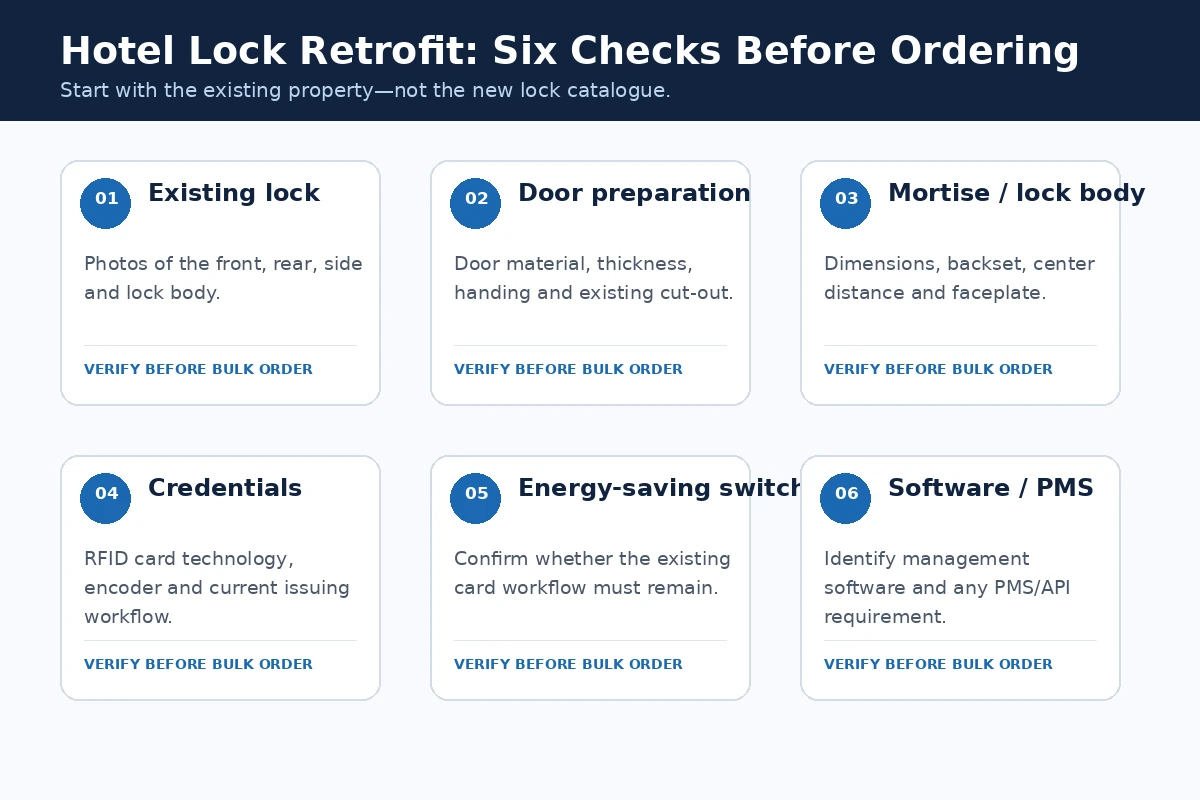
The most important information comes from the existing installation. A good retrofit request normally includes clear photos, measurements and a description of the property's current access workflow.
1. Door type and thickness
Confirm the door material, actual thickness and opening direction. Do not assume that two guest-room doors have the same preparation just because they look similar.
2. Mortise and lock-body dimensions
Record the existing mortise or provide a clear drawing and photos. Backset, center distance, faceplate dimensions, spindle position and screw locations can determine whether a replacement model can use the existing preparation.
For detailed mechanical measurement guidance, see the Hotel Lock Replacement Guide.
3. Existing RFID credentials
Identify the current card technology and how cards are issued. The frequency printed or mentioned by itself is not enough to prove compatibility. The lock, card, encoder and management workflow need to be considered together.
4. Energy-saving switches
Many properties expect the same guest credential to operate both the room lock and room-power workflow. Confirm this during the retrofit survey rather than discovering the mismatch after installation.
5. Software and PMS requirements
Record the current lock-management software, PMS name and the expected integration scope. A hardware replacement does not automatically mean the PMS must be replaced, but any required interface should be checked before production.
For integration planning, see the Hotel Lock PMS Integration Guide.
Can Existing RFID Cards Still Be Used?
They may be, but this should always be verified. A replacement lock can be mechanically compatible with the door and still fail the project's credential requirement.
Before deciding to keep existing cards, confirm:
- the current RFID technology and frequency;
- the card format used by the hotel's management workflow;
- the encoder or card-issuing equipment;
- how guest and staff credentials are managed; and
- whether the energy-saving switch uses the same credential workflow.
SmartLockMarket's guide to 125 kHz vs 13.56 MHz Hotel Key Cards covers the frequency question in more detail. For a retrofit, however, frequency is only one part of the compatibility check.
What About Existing Energy-Saving Switches?
Energy-saving switches are easy to overlook because they are not installed on the guest-room door. Operationally, however, they can be part of the same room-access workflow.
Before approving a replacement hotel lock, confirm whether the property wants to keep the existing room-power switch and whether it relies on the same credential technology as the guest-room lock. If the cards, encoder and switch are changed at the same time, plan the migration as one project rather than three separate purchases.
This is especially important for distributors and project contractors who are preparing a full-room hardware quotation. The lock price alone does not represent the full retrofit scope.
Do You Need to Replace the PMS or Lock Software?
Not necessarily. A property can have a retrofit project where the primary change is door hardware, while the existing PMS remains the same. Another project may require a new lock-management platform, a new encoder workflow, or an interface between the hotel lock system and the PMS.
For that reason, collect the PMS name, version, deployment type and available API or interface documentation where applicable. Ask the supplier to confirm the supported integration path for the exact lock configuration before production.
Do not describe a lock as “PMS compatible” without defining the system and interface being evaluated. Compatibility is a project-level confirmation, not a generic label.
Why Should You Test a Sample Before Bulk Order?
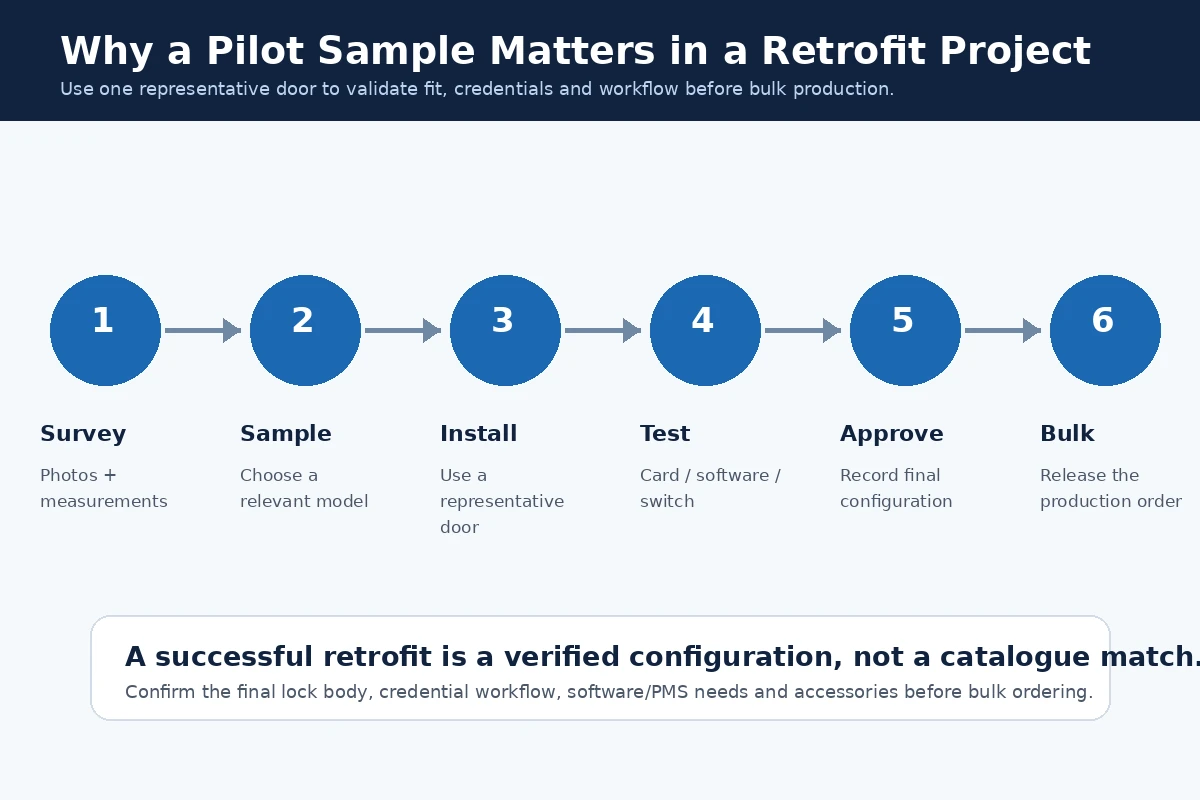
A retrofit project should normally have a pilot stage. The sample should represent the actual installation conditions as closely as possible.
- Survey one representative door.
- Select a model based on the real measurements and system requirements.
- Install the sample using the planned hardware and accessories.
- Test guest credentials, staff access, emergency or mechanical override procedures, the room-power workflow and any required software process.
- Record the approved configuration, including lock model, lock body, cards, encoder, accessories and software requirements.
- Use the approved configuration for the bulk order.
For example, the current 118E-S2-Y Hotel RFID Lock page lists RFID card access and a standard-mount lock body, but it also asks buyers to confirm the mortise, handing, card system and door preparation before ordering. That is the right approach for retrofit procurement: select from the product range, then validate the actual project configuration.
View the 118E-S2-Y Hotel RFID Lock as one example of the type of product page that should be reviewed together with the site-survey information.
When Is a Partial Retrofit Better Than a Full Replacement?
| Project Situation | Potential Approach | Primary Decision Factor |
|---|---|---|
| Mechanical fit is good, electronics are outdated | Evaluate retrofit or compatible replacement electronics | Actual lock platform and parts availability |
| Door preparation is usable, but cards and software are obsolete | Replace the lock system while minimizing door changes | Credential and software migration |
| Door preparation is highly specific | Use a matching lock body or planned door modification | Installation cost and schedule |
| Property wants a different access architecture | Consider a broader system replacement | Operational workflow and integration requirements |
| Property has a mixed lock estate | Pilot a standardized replacement configuration first | Consistency across room types |
A full replacement may be more efficient when the existing hardware is discontinued, door preparation is incompatible, the credential system is no longer supportable, or the hotel wants to change its operating model. The right answer should come from the project constraints rather than from the lowest unit price.
Common Hotel Lock Retrofit Mistakes
Choosing by appearance only
Two locks can look similar while using different mortises, preparations or software environments. Visual similarity is not a compatibility test.
Assuming the same RFID frequency means the same cards will work
Credential technology, encoding and software workflow must be confirmed together.
Ordering the bulk quantity before a representative sample
A sample gives the project team a chance to uncover installation or workflow issues before they affect the full property.
Forgetting the room-power workflow
If the hotel relies on an energy-saving switch, include it in the retrofit test rather than treating it as a separate accessory purchase.
Calling a system “PMS compatible” without verifying the interface
PMS name, version and integration method matter. Document the exact requirements before describing the project as compatible.
Hotel Lock Retrofit Checklist
Before requesting a quotation, prepare the following:
| Information to Send | Recommended Detail |
|---|---|
| Project type | Hotel renovation, replacement, expansion or mixed-property standardization |
| Room quantity | Guest rooms plus relevant common or staff doors |
| Door information | Material, thickness, opening direction and photos |
| Existing lock | Front, rear, side and lock-body photos; existing model if known |
| Mortise information | Lock-body drawing, backset, center distance, faceplate and cut-out measurements |
| RFID credentials | Current card type, frequency, encoder and issuing workflow |
| Room-power system | Existing energy-saving switch and whether it must remain |
| Software / PMS | System name, version, interface/API needs and current workflow |
| Project accessories | Cards, encoders, software, gateways, spare parts or mechanical keys as required |
| Branding | Logo, finish, packaging and OEM/ODM requirements if applicable |
| Sample requirement | Representative door or room for pilot testing |
| Target schedule | Sample date, approval date and planned bulk installation |
For broader product selection, compare the available Hotel RFID Locks and confirm the final model only after the project requirements are reviewed.
FAQ
Can I replace hotel locks without changing the door?
Sometimes. The replacement can use the existing door preparation when the lock body, dimensions, handing and accessories are compatible. If the preparation differs, the project may require a lock-body change or door modification. Confirm with photos, measurements and a sample before bulk ordering.
Can I keep the hotel's existing RFID cards?
Possibly, but do not assume compatibility from the card frequency alone. Confirm the credential technology, encoder, management workflow and any room-power application before deciding to keep the existing cards.
Do I need to replace the hotel PMS when replacing the locks?
Not always. Some replacement projects are mainly hardware changes. Others need a new lock-management setup or PMS interface. The PMS name, version and required integration method should be reviewed before the lock configuration is finalized.
Should I test one hotel lock before placing a bulk order?
Yes. A representative sample helps verify physical fit, credential operation, room-power workflow, software processes and installation requirements before the same configuration is deployed across the property.
What information should I send a hotel lock supplier for a retrofit project?
Send the room quantity, door material and thickness, existing-lock photos, mortise or cut-out dimensions, opening direction, current RFID card information, encoder details, energy-saving switch requirements, software/PMS information and the target project schedule.
Can a retrofit use a different lock model from the original hotel lock?
Potentially. A different model may work when its lock body, door preparation, credential system and management workflow meet the project's requirements. The correct decision should be based on the actual property data and sample testing rather than the model number alone.
Need Help With a Hotel Lock Retrofit Project?
Send SmartLockMarket the existing lock photos, door measurements, room quantity, current card or software information and project schedule. We can review the retrofit requirements and recommend a suitable hotel lock configuration for quotation and sample evaluation.
Contact SmartLockMarket for a hotel lock retrofit quotation.