smartlockmarket.com

Smart Lock OEM vs ODM: What B2B Buyers Should Know Before Requesting a Quote
For a smart lock buyer, “OEM” and “ODM” can sound like simple supplier labels. In practice, the difference matters because it changes what must be confirmed, how much engineering work may be involved, and what should be approved before a sample or bulk order.
This guide is for distributors, importers, private-label brands, hotel and apartment project buyers, and door or access-control companies preparing a smart lock RFQ. It explains how to separate standard private-label customization from deeper product development, what information to send a supplier, and how to reduce avoidable changes between quotation, sample approval, and mass production.
Table of Contents
1. OEM vs ODM: the Practical Difference
The terms OEM and ODM are not used in exactly the same way by every smart lock supplier. For procurement, the safest approach is to ignore the label at first and confirm the actual work scope in writing.
As a practical purchasing distinction, an OEM smart lock project usually starts with an existing lock model or platform. The buyer may request private-label branding, packaging, available finishes, selected electronic configurations, or other options already supported by that product family.
An ODM smart lock project normally requires deeper product changes. Depending on the project, this can include a new housing, structural changes, tooling, electronics changes, firmware work, a new access combination, or another requirement that is not already available as a standard option.
| Comparison | OEM Smart Lock Project | ODM Smart Lock Project |
|---|---|---|
| Starting point | Existing smart lock model or validated platform | Existing platform with deeper development, or a buyer-specific design requirement |
| Typical scope | Logo, labels, packaging, available colors, manuals, supported electronic configurations | Housing, structure, tooling, electronics, firmware, or new feature combinations |
| Engineering work | Usually limited if the requested options already exist | May require engineering review, prototype work, tooling, or validation |
| Development risk | Usually lower because the base model already exists | Usually higher because more items may need development and testing |
| MOQ | Depends on model, branding, packaging, and configuration | Depends heavily on development scope, tooling, materials, and production conditions |
| Lead time | Normally shorter than a development-heavy project, subject to the selected customization | Usually longer because design, tooling, samples, and validation may be required |
| Best suited for | Distributors, private-label brands, wholesalers, and project buyers using an existing platform | Buyers needing product differentiation beyond standard available options |
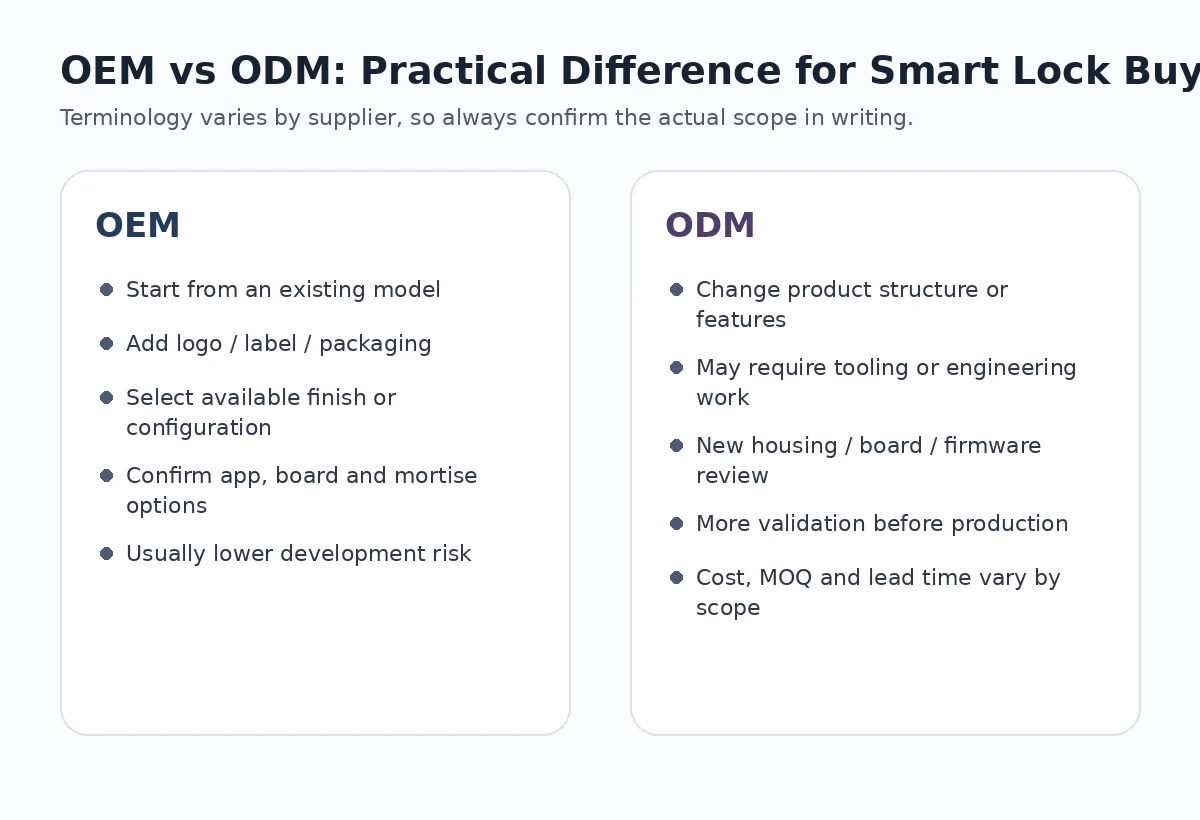
The key question is therefore not “Does the supplier offer OEM/ODM?” The useful question is: Which parts of this exact model can be changed, what must be newly developed, and what has to be approved before production?
2. What Usually Fits an OEM Smart Lock Project?
OEM work often focuses on turning an existing, validated smart lock platform into a product suitable for the buyer’s brand, market, or project. The available scope depends on the specific model.
Private-label branding
Common requests include a logo on the lock, product label, carton label, manual, warranty card, or branded packaging. The supplier should confirm the available logo method, position, size, artwork format, and whether the sample will include final branding.
Finish and appearance options
Some models may be available in more than one color or surface finish. Buyers should confirm which finishes already exist for the selected model instead of assuming any catalog color can be applied to every lock.
Packaging and documentation
Private-label programs may require customized cartons, labels, manuals, installation sheets, inserts, accessory lists, or barcode information. These items should be approved together with the hardware because packaging changes can affect cost, MOQ, and production preparation.
Existing electronic or access configurations
A product family may have different board, APP, credential, or access-method versions. For example, some smart lock models may support TTLock, Tuya, a standalone configuration, an RFID hotel system, or another board option. Availability must be confirmed for the exact model and version rather than assumed across the entire catalog.
SmartLockMarket’s current OEM/ODM overview explains the customization areas we can review for distributors, brands, and project buyers. Final availability, MOQ, sample cost, and production schedule are confirmed by model and project scope.
3. When Does a Project Become ODM?
A project starts moving beyond routine private labeling when the buyer requests changes that require product engineering, new tooling, electronics development, firmware modification, or a new combination that has not already been validated on the selected lock.
Examples can include:
- a new front or rear housing design;
- a different internal mechanical structure;
- a custom mortise or installation requirement not covered by available options;
- new electronic-board requirements;
- feature combinations not available in the current version;
- firmware or workflow changes that require technical development;
- new tooling for a buyer-specific appearance.
Not every request is technically or commercially suitable for every model. A supplier should review the requirement first, separate standard options from development work, and identify which items require engineering confirmation.
For buyers, this matters because an apparently small feature request can affect tooling, validation, compatibility, certification scope, MOQ, or the development schedule. The RFQ should therefore distinguish between must-have requirements and preferred options.
4. Hardware, Software, and Door Compatibility Must Be Confirmed Together
Smart lock customization is not only about the visible panel. A lock is a combination of mechanical hardware, electronics, access methods, power supply, software or management platform, and the actual door or locker structure.
Door and mortise fit
Before a supplier confirms a model, provide the door material, door thickness, opening direction, existing lock-body or mortise dimensions, backset, center distance where relevant, and clear photos or drawings. For replacement projects, the existing cut-out can be more important than the appearance of the new lock.
This is especially important for security doors, aluminum doors, hotel doors, and other applications where the lock body must match an existing preparation. SmartLockMarket product pages therefore ask buyers to confirm door and mortise details before bulk production.
Access method
State the required access methods separately: fingerprint, keypad, RFID card, mobile APP, mechanical key, face recognition, or a combination. Do not use “smart lock” as the only functional requirement.
APP or management platform
If your project requires TTLock, Tuya, a hotel card system, a standalone lock, or another management workflow, include that requirement in the first RFQ. The same external lock design may have different electronic configurations, so the platform should be part of the approved specification.
For examples of current product categories, buyers can compare fingerprint door locks, hotel RFID locks, and RFID locker locks before requesting a model recommendation.
5. Why Cost, MOQ, and Lead Time Change by OEM/ODM Scope
There is no useful universal MOQ or lead time for all smart lock OEM/ODM projects. The commercial conditions depend on what is being changed.
A stock or sample order with no custom work is different from a private-label order with custom packaging. A private-label order is different again from a project that requires new tooling, electronics changes, or buyer-specific development.
The main variables normally include:
- selected lock model and hardware configuration;
- logo method and branding requirements;
- custom color, finish, or material requirements;
- packaging, manual, label, and accessory customization;
- electronic board, APP, RFID, or system configuration;
- tooling or development work;
- sample quantity and bulk quantity;
- testing, compliance, or documentation requirements;
- production capacity and material availability at the time of order.
For this reason, a buyer should request a configuration-specific quotation. The quotation or PI should identify the model, version, key options, quantity, branding scope, packaging scope, and any separately charged development or tooling items.
6. From Sample to Bulk Production
A reliable custom smart lock project should use approval gates instead of moving directly from a product photo to a bulk order.
| Stage | Buyer Input | Supplier Output / Approval Point |
|---|---|---|
| 1. RFQ review | Application, door details, access methods, platform, quantity, market, customization | Suitable model recommendation and preliminary customization feasibility |
| 2. Configuration confirmation | Confirm required model, mortise, finish, electronics, software, accessories | Configuration-specific quotation and specification |
| 3. Sample evaluation | Install and test the sample on a representative door or locker | Fit, unlocking methods, APP/system behavior, accessories, and installation are verified |
| 4. Specification approval | Approve final hardware and electronic configuration | Written specification becomes the reference for production |
| 5. Branding approval | Approve logo, labels, manual, packaging, barcode, and other brand elements | Final artwork and packaging scope are frozen |
| 6. Bulk production | Confirm order quantity and shipment requirements | Production, inspection, packing, and export preparation |
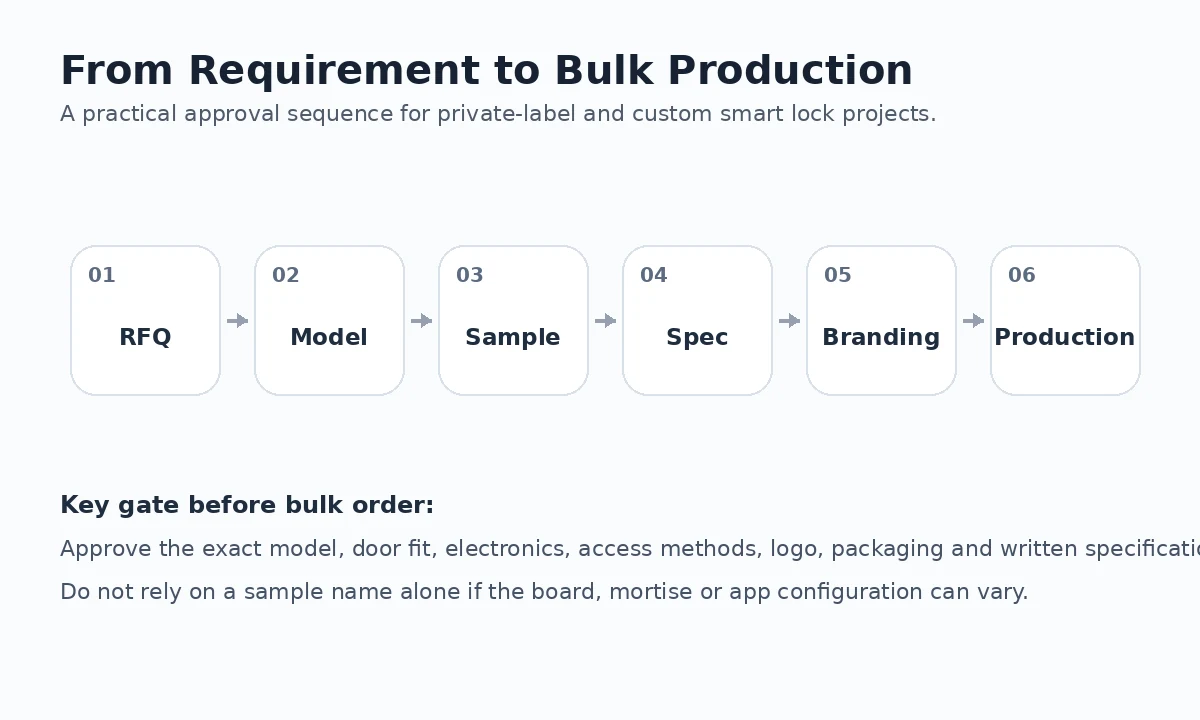
Step 1: RFQ and requirement review
Send the application, door information, access methods, platform requirements, estimated quantity, target market, and customization list. The supplier can then recommend suitable existing models or identify where development is required.
Step 2: model and configuration confirmation
Confirm the exact model and version. For models with multiple boards, mortises, colors, or access configurations, record those options in the quotation.
Step 3: sample evaluation
Test the sample on a representative door or locker. Check mechanical fit, unlocking methods, user enrollment, APP or system behavior, battery access, emergency access, and installation requirements.
Step 4: written specification approval
The approved specification should match the sample or clearly state any changes after sample testing. Do not rely only on the model name if multiple configurations exist.
Step 5: branding and packaging approval
Approve logo position, artwork, labels, manual content, packaging, accessories, and any customer-specific markings before mass production.
Step 6: production and pre-shipment checks
The agreed inspection scope should cover the relevant product functions, appearance, accessories, labels, and packaging. For project orders, buyers may also need spare parts or agreed replacement components listed separately.
7. Smart Lock OEM/ODM RFQ Checklist
A detailed first enquiry reduces repeated emails and makes it easier for the supplier to recommend a compatible model.
| RFQ Item | Information to Provide | Why It Matters |
|---|---|---|
| Application | Hotel, apartment, home, office, locker, villa, security door, aluminum door, etc. | Determines the suitable lock category and operating environment |
| Door / locker | Material, thickness, handing, profile, mortise, cut-out, backset, center distance, photos or drawings | Prevents installation and compatibility problems |
| Access methods | Fingerprint, PIN, RFID, APP, key, face recognition, or other combinations | Defines the required electronics and user workflow |
| Platform / system | TTLock, Tuya, hotel system, standalone, or supplier recommendation | Confirms board, software, gateway, encoder, or management requirements |
| Customization | Logo, finish, packaging, manual, labels, electronics, accessories, structural changes | Separates standard OEM options from development-heavy ODM work |
| Quantity | Sample quantity and estimated first bulk order | Supports realistic MOQ, pricing, and production planning |
| Destination market | Country or region and known compliance/document requirements | Helps confirm documentation and configuration requirements |
| Schedule | Target sample date and expected bulk order or project date | Allows the supplier to assess sample and production timing |
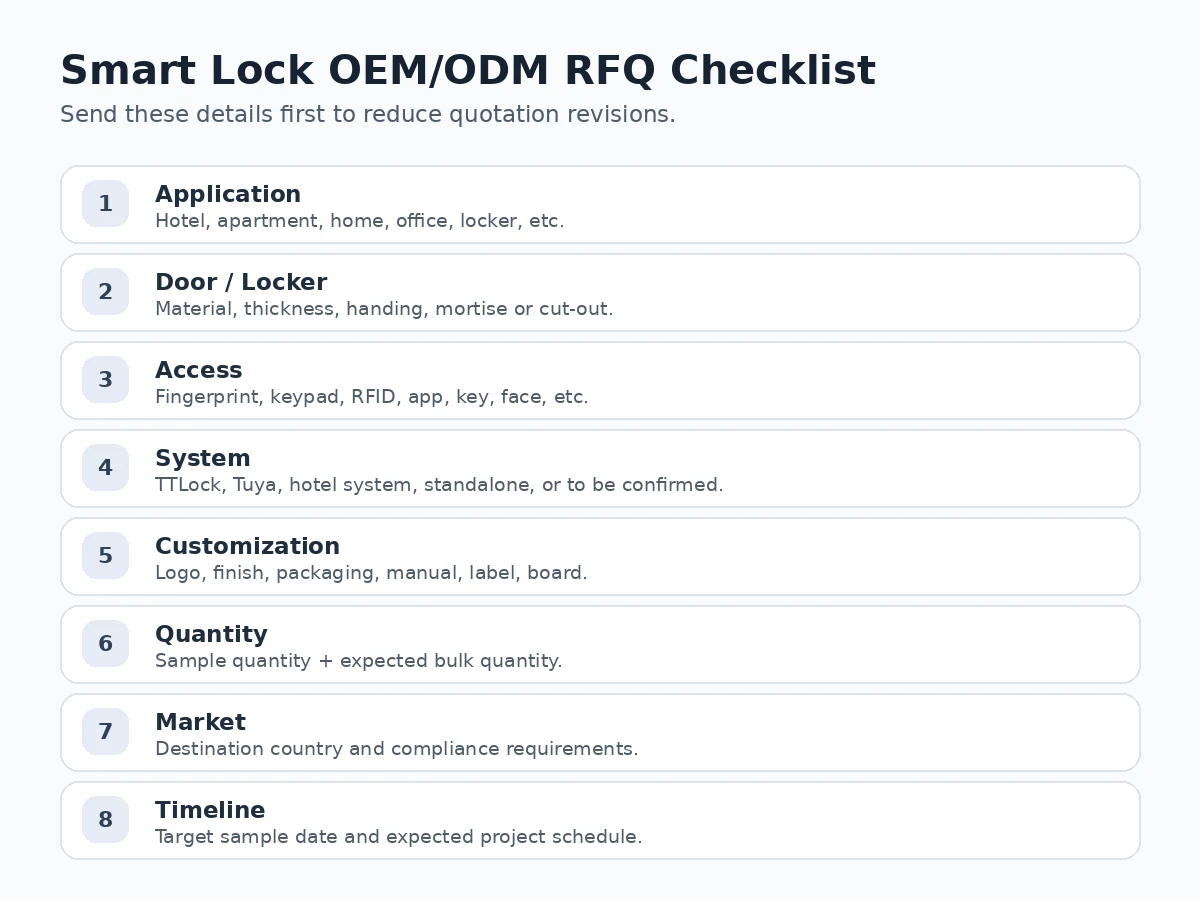
At minimum, include:
- Application: hotel, apartment, home, office, locker, villa, security door, aluminum door, or another scenario.
- Door or locker information: material, thickness, handing, profile, mortise, cut-out, backset, center distance, and photos or drawings where applicable.
- Required access methods: fingerprint, PIN, RFID, APP, key, face recognition, or another combination.
- Platform or workflow: TTLock, Tuya, hotel management system, standalone operation, or “recommend based on project.”
- Customization: logo, finish, packaging, manuals, labels, electronics, accessories, or structural changes.
- Quantity: required sample quantity and estimated first bulk order.
- Destination market: country or region plus any known compliance or documentation requirements.
- Schedule: when samples are needed and the target bulk-purchase or project date.
If you are not sure which model fits, send the door information first. A supplier can recommend suitable products more accurately from the installation conditions than from appearance alone.
8. How to Compare Smart Lock OEM/ODM Suppliers
| Supplier Check | What a Buyer Should Verify |
|---|---|
| Model identification | The quotation identifies the exact model and configuration, not only a generic product name. |
| Door compatibility | Door thickness, mortise, backset, center distance, handing, and cut-out are reviewed where relevant. |
| Electronics / software | APP, RFID, board, gateway, encoder, hotel system, or standalone workflow is clearly confirmed. |
| Customization scope | Logo, finish, packaging, manuals, labels, and any development work are listed separately. |
| Sample approval | A representative sample can be tested before bulk production. |
| Change control | Changes after sample approval are recorded in an updated written specification. |
| After-sales | Spare parts, replacement handling, warranty responsibilities, and support scope are clarified. |
| Compliance documents | Required documents are matched to the exact quoted model and destination market where applicable. |
Do not compare suppliers only by the lowest quoted unit price. First check whether the quotations describe the same configuration and service scope.
Useful comparison points include:
- whether the supplier clearly identifies the model and configuration;
- whether door and mortise compatibility is reviewed before production;
- whether APP, board, RFID, or management-system requirements are confirmed;
- whether branding and packaging options are written into the quotation;
- whether samples can be tested before bulk production;
- whether changes after sample approval are controlled in writing;
- whether spare parts, warranty handling, and after-sales responsibilities are clarified;
- whether certification or compliance documents are matched to the exact quoted model where required.
SmartLockMarket is a China-based smart lock manufacturer and B2B supplier serving distributors, wholesalers, brands, and project buyers. Our current process covers product recommendation, sample and specification confirmation, branding and packaging confirmation, production, inspection, and export coordination. See About SmartLockMarket for the current OEM/ODM process and manufacturing overview.
9. Frequently Asked Questions
What is the difference between OEM and ODM smart locks?
In practical purchasing terms, OEM commonly starts from an existing smart lock model and applies available branding, packaging, finish, or configuration options. ODM usually involves deeper product development such as structural, tooling, electronics, firmware, or other buyer-specific changes. Supplier terminology varies, so confirm the exact scope in writing.
Can I put my logo on an existing smart lock?
Private-label logo options may be available on suitable models. The method, logo position, artwork requirements, MOQ, sample cost, and production conditions depend on the model and should be confirmed before ordering.
Can I choose TTLock or Tuya for an OEM smart lock?
Some product families have different electronic or APP configurations, but TTLock or Tuya availability is model-specific. Include the required platform in the RFQ and confirm the exact board and software configuration in the quotation.
What information should I send before requesting a smart lock OEM quotation?
Send the application, door or locker information, required access methods, APP or system preference, sample and bulk quantity, destination market, branding requirements, and target schedule. Door photos, mortise drawings, or profile drawings are particularly useful for compatibility review.
Should I order a sample before a bulk OEM order?
For a new model, new door application, new electronic configuration, or private-label program, sample evaluation is strongly recommended. Test mechanical fit, access functions, APP or system behavior, accessories, and the approved configuration before bulk production.
Does OEM/ODM always require a high MOQ?
No single MOQ applies to every project. Minimum order requirements depend on the model, customization type, packaging, electronics, development work, and production conditions. Ask for the MOQ of the exact configuration you need.
Prepare Your Smart Lock RFQ
If you are sourcing smart locks for distribution, private label, hotel, residential, door, or locker projects, send your application, door information, required functions, quantity, destination market, and customization requirements through our Contact Us page. We can review suitable models and confirm the available OEM/ODM scope for the quoted configuration.