smartlockmarket.com

125 kHz vs 13.56 MHz Hotel Key Cards: Which RFID Frequency Should You Choose?
When selecting an RFID hotel lock system, buyers often see two common card frequencies: 125 kHz and 13.56 MHz.
At first glance, the difference may appear simple: 125 kHz is usually called low frequency (LF), while 13.56 MHz is high frequency (HF). However, for a hotel project, choosing the right card involves more than comparing frequencies.
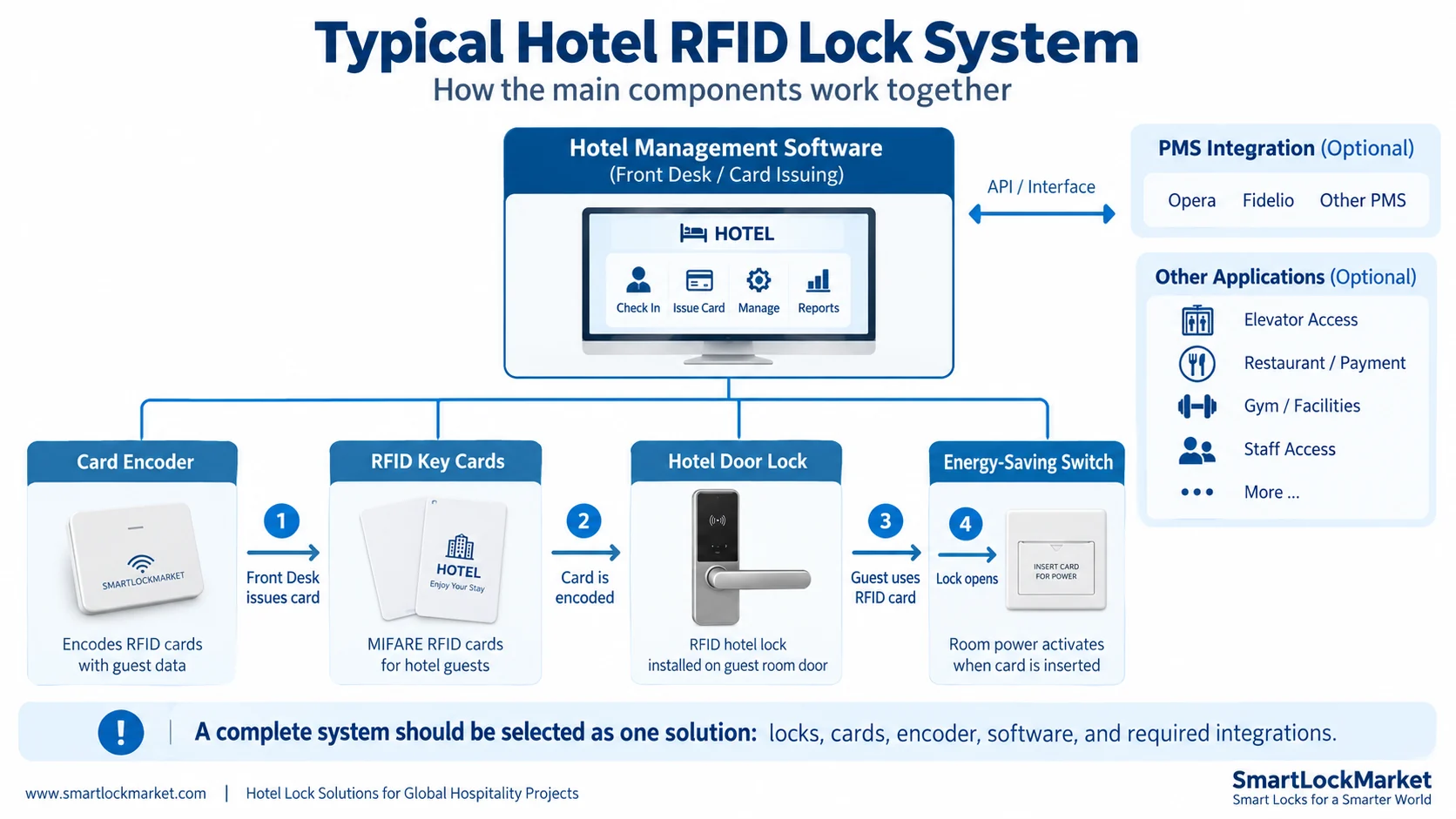
The hotel door lock, key card, card encoder, management software and energy-saving switch may all need to work together. If an existing hotel already has card-operated power switches or other card-based systems, compatibility becomes even more important.
The single most important principle in this guide: frequency is only one part of compatibility. Two cards can both operate at 13.56 MHz — or both at 125 kHz — and still be unable to work with the same lock, because the underlying chip technology, credential format and system configuration also have to match.
This guide explains the practical differences between 125 kHz and 13.56 MHz hotel key cards, and what hotel owners, distributors and project buyers should confirm before ordering hotel RFID locks.
TL;DR — The 30-second version:
- 125 kHz (LF) = legacy proximity cards (EM4100, T5577). Simple and low-cost; still useful when an existing hotel must keep its current cards and power switches.
- 13.56 MHz (HF) = smart cards (MIFARE Classic, Ultralight, Plus, DESFire, CPU). The standard choice for new hotels and full upgrades, with more memory, stronger security and multi-application support.
- The rule: frequency alone does not guarantee compatibility. Confirm the chip, data format, reader, encoder and software before ordering — and sample-test first.
What Is a 125 kHz Hotel Key Card?
A 125 kHz RFID card operates in the low-frequency RFID range.
In hotel and access-control applications, 125 kHz systems are commonly associated with simple proximity credentials such as:
- EM-type cards (EM4100 / EM4102 and compatible chips) — the most common legacy LF credential, which transmits a read-only ID number
- T5577-type cards — a writable LF chip often used when the hotel system needs to store data on the card
- Other legacy proximity technologies used by older lock brands
These systems are typically used where the main requirement is straightforward card identification and door access. The card carries an identifier (and, in some systems, a limited amount of data), the lock reads it, and the door opens.
A typical hotel workflow looks like this:
Front Desk → Card Encoder → Guest Card → Hotel Door Lock
Depending on the system design, the same credential may also interact with a compatible hotel energy-saving switch.
When 125 kHz Still Makes Sense
125 kHz hotel lock systems can still be a suitable choice, especially where:
- The hotel already uses a compatible 125 kHz system
- The project requires relatively simple guest-room access
- Existing energy-saving switches must remain in use
- The buyer wants to replace locks without changing the complete hotel card infrastructure
- The system has already been tested and proven for the specific project
The 125 kHz Caveat
Buyers should not assume that every 125 kHz card works with every 125 kHz lock. Even within 125 kHz, compatibility depends on chip type (EM4100 vs T5577), data format, lock reader firmware, and how the encoder and hotel management software issue guest cards.
What Is a 13.56 MHz Hotel Key Card?
A 13.56 MHz RFID card operates in the high-frequency range.
Hotel cards almost always conform to the ISO 14443 contactless smart-card standard — Type A (used by all MIFARE chips) or, less commonly in hotels, Type B. A separate 13.56 MHz standard, ISO 15693, is a longer-range "vicinity" standard used mainly for asset tags, library books and logistics labels — it is not typically used for hotel door locks.
Common 13.56 MHz contactless technologies used in hotel projects include:
- MIFARE Classic (1K / 4K) — widely used in hotel locks; divides memory into sectors protected by keys, and supports read/write functions
- MIFARE Ultralight — a low-cost chip with limited memory, often used for simpler credentials or disposable applications
- MIFARE Plus — a security-enhanced evolution of Classic with AES encryption; relevant for hotels wanting better cloning resistance while staying cost-effective
- MIFARE DESFire (EV2/EV3) — supports advanced encryption and multiple applications; common in higher-security projects
- CPU cards — smart cards with an embedded microprocessor, cryptographic authentication and secure key management, typically required for payment-grade applications
- Other ISO 14443-based hotel card technologies
Compared with basic 125 kHz proximity credentials, most 13.56 MHz smart cards support read/write functions, usable memory and more advanced credential management.
For hotel projects, 13.56 MHz cards are widely chosen when buyers need a modern hotel RFID lock system that may include guest-room access, card encoding at reception, card validity dates, staff or master-card permissions, energy-saving switches, elevator access and other compatible hotel applications.
The 13.56 MHz Caveat
The exact functions still depend on the hotel lock system and software. A 13.56 MHz card does not automatically support every hotel application simply because of its frequency.
In particular, a MIFARE Classic, MIFARE Ultralight and DESFire card are not interchangeable, even though all operate at 13.56 MHz. Hotel lock brands often use proprietary data structures written into card sectors, so cards from different lock systems usually cannot be mixed.
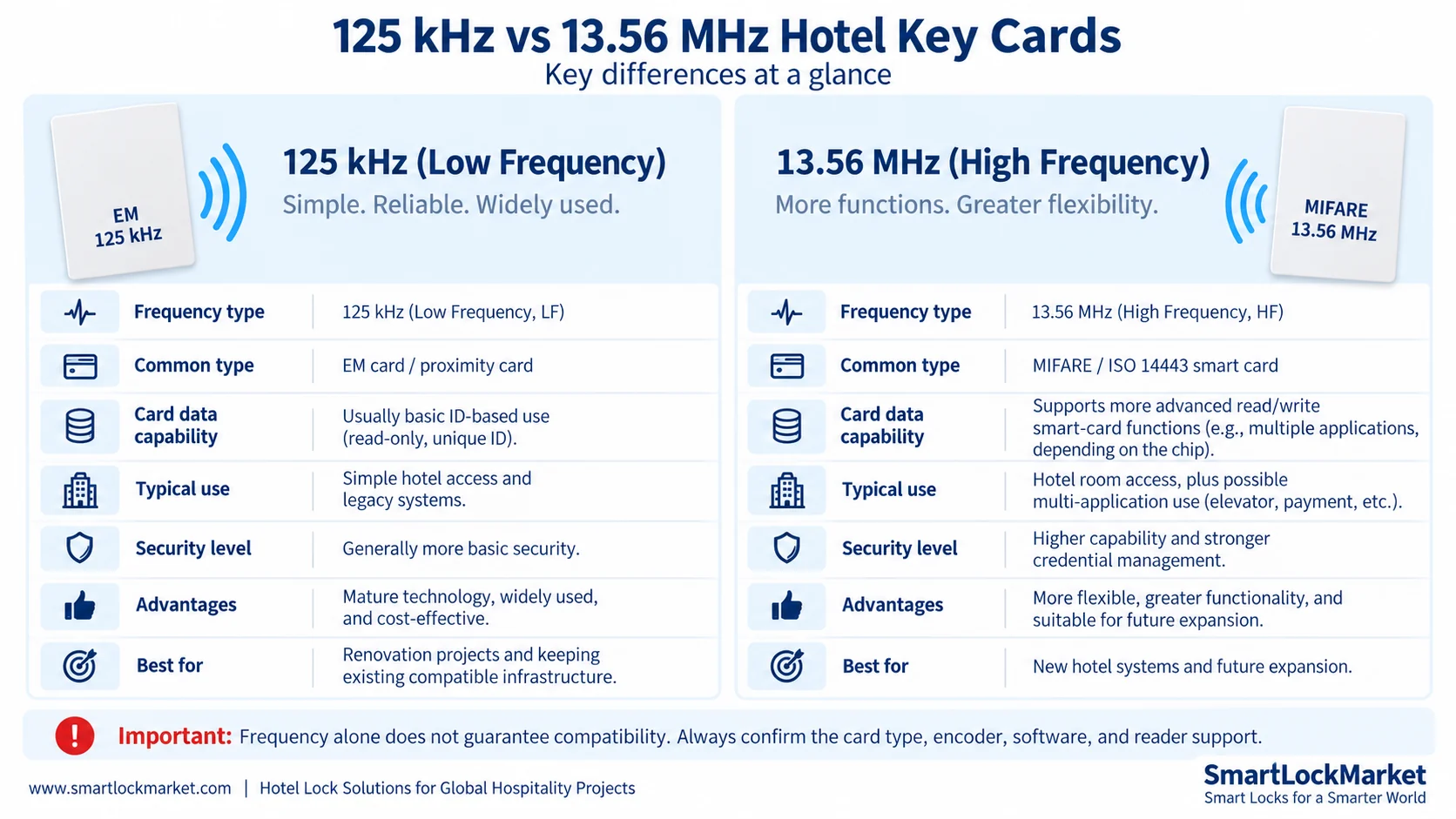
125 kHz vs 13.56 MHz Hotel Key Cards: Main Differences
| Item | 125 kHz (LF) | 13.56 MHz (HF) |
|---|---|---|
| Frequency Type | Low Frequency | High Frequency |
| Common Chips / Technologies | EM4100, T5577 and other legacy proximity chips | MIFARE Classic, MIFARE Plus, MIFARE DESFire, MIFARE Ultralight, CPU cards and other supported ISO 14443 credentials |
| Typical Function | Read-only or simple read/write identification | Access plus read/write memory, sectors and multi-application support |
| Card Memory | Usually limited or ID-based, depending on the chip and system design | Varies by card type and chip version, from simple low-memory credentials to multi-kilobyte smart cards |
| Security Capability | Basic in legacy systems (IDs can be read or cloned with inexpensive equipment) | Supports key-protected sectors, mutual authentication and, on CPU/DESFire chips, strong cryptography |
| Typical Read Range | Depends on reader, antenna, card and installation design | Depends on reader, antenna, card and installation design |
| Hotel Door Access | Yes, with compatible system | Yes, with compatible system |
| Energy-Saving Switch | Possible with compatible switch | Possible with compatible switch |
| Multi-Application Potential | Very limited | Generally greater — one card can potentially combine access, elevator, payments and staff functions |
| Future Expandability | Low — legacy technology, fewer new systems support it | High — mainstream standard for new hotel lock systems |
| Best Fit | Renovations where legacy LF infrastructure must stay | New hotels and full-system upgrades |
| Compatibility Rule | Must confirm chip, encoding, reader, encoder and software | Must confirm chip type, data structure, reader, encoder, software and application |
For hotel door locks, read range should not be the main factor when selecting a key-card system. Compatibility with the lock reader, card chip, encoder, software and energy-saving switch is more important.
Three practical takeaways from this table:
- Security and expandability are where 13.56 MHz generally leads, especially with DESFire or CPU cards.
- Cost and legacy compatibility are where 125 kHz retains a place, particularly in renovations.
- Frequency is only one compatibility factor — chip type, data format and system configuration must also match.
Can the Same Hotel Card Open the Door and Activate the Power Switch?
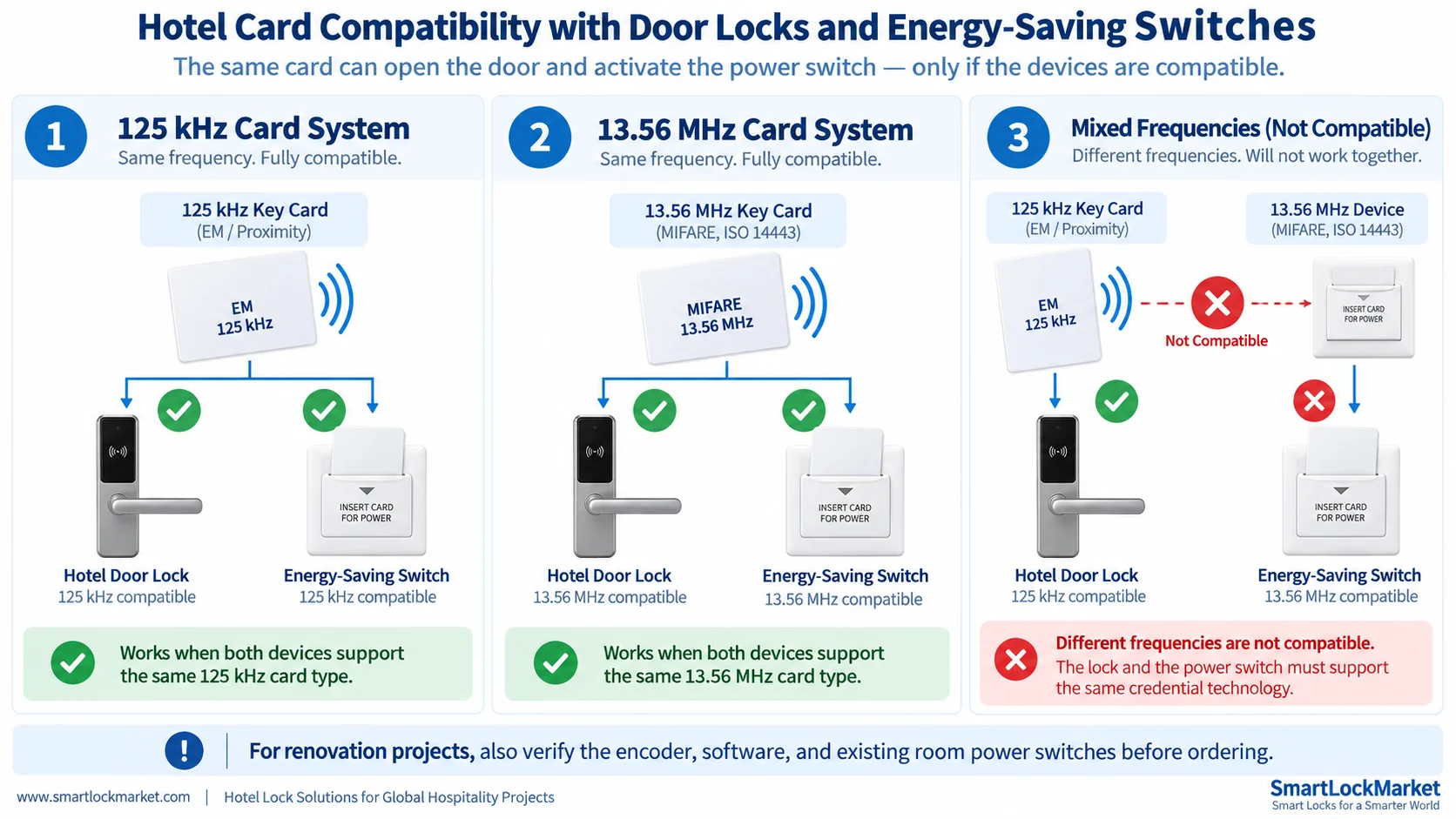
Yes, in many hotel projects the same guest card can be used for both opening the hotel room door and activating the room's energy-saving switch (card-operated power switch). But this only works when the devices are compatible.
For example, if a hotel already has an RFID energy-saving switch installed inside each guest room, the buyer should identify what type of card the switch accepts before purchasing new hotel RFID locks. Do not assume that a new lock will automatically work with the existing power switch.
For an Existing Hotel
Before replacing the locks, check the existing key-card frequency, card chip or type, energy-saving switch specification, card encoder, hotel lock management software and whether existing cards are intended to remain in use.
If the existing energy-saving switches only recognize a particular credential — for example, a T5577 125 kHz card — the new lock system must use a compatible card. Otherwise, the hotel may need to replace or reconfigure the energy-saving switches as part of the project, which adds cost, labor and room downtime.
Why This Matters: A Common and Expensive Mistake
Imagine a hotel replaces 200 door locks without checking the existing power switches. The new cards open the guest-room doors — but cannot activate the room electricity. The hotel then faces a second, unplanned project involving hundreds of energy-saving switches, plus guest complaints in the meantime.
This is why card compatibility should be checked before placing the bulk lock order, ideally through sample testing.
Replacing an Existing Hotel Lock System?
Send us photos of your existing key card, encoder, energy-saving switch and door lock. We can help check which hotel RFID lock configuration should be tested before bulk ordering.
Does 13.56 MHz Mean the Card Can Be Used for Payments?
Not automatically — and this is one of the most common misunderstandings among hotel buyers.
Some 13.56 MHz smart-card systems can support multiple applications — room access, elevator control, energy-saving switches, F&B or spa access, and staff credentials — but simply purchasing a 13.56 MHz hotel key card does not create these functions. Payment capability depends on the card chip architecture and the system behind it:
- MIFARE Classic / Ultralight — fine for access control and stored identifiers, but not designed for secure payment applications. Their authentication has known weaknesses for financial use.
- MIFARE DESFire / CPU cards — designed for applications that require strong cryptographic authentication, secure key management and certified security. These are the chip types typically found in payment or high-security deployments.
A complete multi-application system also requires compatible cards, readers, software, data structure and application permissions — and, for payments, often a certified transaction platform. If your hotel wants an all-in-one card system, define the required applications before selecting the credential platform.
Which Frequency Is Better for a New Hotel Project?
There is no single frequency that is automatically correct for every hotel. For a completely new hotel project, buyers should begin with the required operating workflow rather than the frequency.
Ask how reception will issue guest cards, whether offline or networked locks are required, whether the card will activate the room power switch, whether elevator access is needed, whether one card should cover multiple facilities now or later, whether PMS integration is required, whether existing access-control systems need to share credentials, what level of credential security is needed, and whether replacement cards must be sourced locally in the future.
The Short Answer for New Builds
For most new hotel projects, 13.56 MHz smart-card systems are the recommended direction because they offer better expandability for elevator control and staff management, stronger supply continuity through ISO 14443 / MIFARE-compatible platforms, and stronger security options such as DESFire or CPU cards.
However, if the requirement is simply reliable guest-room access with a proven offline hotel lock system, and the project budget favors 125 kHz, both technologies may still be considered depending on the project configuration. For a broader purchasing checklist, see our Hotel RFID Locks Buying Guide.
What About Existing Hotel Renovation Projects?
Renovation projects require more careful compatibility checking than new-build projects, because the hotel may already have cards, encoders, software, energy-saving switches, elevator readers, staff cards and existing door mortises.
Changing one part of the system can affect several other components. Three typical renovation scenarios illustrate this:
Example 1: Keep the Existing Energy-Saving Switches
A hotel wants to replace the guest-room locks but keep its current energy-saving switches. Before selecting the new locks, confirm the existing card type and whether the proposed lock can operate with a compatible credential. If the switches only accept, say, an EM4100 card, the new lock system must issue EM4100-compatible guest cards — which may rule out otherwise attractive 13.56 MHz lock models.
Example 2: Replace the Complete Hotel Lock System
If the old system has reached the end of its service life, it may be more practical to evaluate the locks, cards, encoder and software as one complete hotel lock system. This is the natural opportunity to move from legacy 125 kHz to a 13.56 MHz smart-card platform, including new energy-saving switches.
Example 3: Existing PMS Must Remain
RFID frequency alone does not determine PMS compatibility. If the hotel needs the new hotel lock software to communicate with an existing PMS, the integration method must be checked separately. The hotel IT team may need to review an API, interface function, middleware or other integration method supplied with the selected system.
Card frequency is only one part of a hotel access-control project. If the hotel also needs to connect the lock software with an existing PMS, see our PMS integration for hotel lock systems.
How to Check Your Existing Hotel Card System
If you do not know whether the existing hotel uses 125 kHz or 13.56 MHz cards, do not guess. Collect information from the existing system and send it to the hotel lock supplier.
1. Photograph the Existing Key Card
Send clear photos of both sides of the card. If any model number, chip description or technical marking is visible (for example "EM4100" or "MIFARE 1K S50"), include a close-up photograph.
2. Check the Encoder and Energy-Saving Switch
Photograph the reception encoder and room power switch, including brand, model, label and any stated card specification. Note the existing software name and version if visible.
3. Provide Existing Lock Information
Send photographs of the current lock front panel, back panel, door edge, mortise and existing cutout. If technical records are still available, ask the existing supplier to confirm RFID frequency, card chip, encoder model and energy-switch requirement.
What Buyers Should Confirm Before Ordering Hotel RFID Locks
When requesting a quotation, do not send only:
"We need 200 hotel RFID locks."
That information is not enough to confirm system compatibility. For an accurate hotel lock proposal, provide the following.
Hotel Project Information
- New hotel or renovation
- Number of guest rooms and locks required
- Country and hotel type (budget, business, resort, serviced apartments)
- Estimated installation schedule
Door Information
- Door material, thickness, existing mortise, backset and center distance
- Door opening direction
- Photos of the existing door and lock
RFID System Information
- Required card frequency, if known
- Existing card type and chip
- Existing energy-saving switch and its accepted card
- Existing encoder and software
- Whether existing cards must remain usable
System Requirements
- Room door access, energy-saving switch and elevator access
- PMS integration
- Staff or master cards and multi-application card requirements (now or planned)
- OEM logo or packaging requirements
Sample Testing Before Bulk Orders
For large renovation projects, sample testing is strongly recommended before bulk production. Test the lock, card, encoder, software and energy-saving switch together:
- Issue a guest card with the encoder and software
- Confirm the card opens the sample lock
- Insert the same card into the energy-saving switch and confirm power activation
- Test card expiry and lost-card handling
- Confirm PMS communication, if required
A one-week sample test can prevent a project-wide compatibility failure.
Need a Hotel RFID Lock Recommendation?
Send us your project quantity, door photos and existing card information. We can recommend a suitable configuration for your hotel project.
Frequency Alone Does Not Guarantee Compatibility
Matching frequency labels — 125 kHz → 125 kHz or 13.56 MHz → 13.56 MHz — does not guarantee interoperability. Compatibility actually depends on:
- Card chip (EM4100 vs T5577; MIFARE Classic vs Ultralight vs DESFire vs CPU)
- Credential format and data structure
- Encoding method
- Reader technology
- Authentication method and keys
- Hotel lock firmware
- Encoder
- Management software
- Application configuration
A concrete example: a MIFARE Classic 1K card from Lock Brand A and a MIFARE Classic 1K card from Lock Brand B are both 13.56 MHz, both ISO 14443A, and both MIFARE — yet they will not open each other's locks, because each brand writes its own proprietary data into different sectors with its own keys.
Therefore, always confirm the complete system. Frequency is only one factor. Actual compatibility also depends on the card chip, reader, encoder, software configuration, data format and connected hotel devices. For B2B hotel projects, the safest approach is to test the actual card and system configuration before ordering hundreds of locks.
A Simple Selection Guide: 125 kHz or 13.56 MHz
In practice, project type often points the direction:
- Existing 125 kHz infrastructure to keep → confirm chip, encoder and energy-switch compatibility; sample-test before bulk ordering.
- New build or full replacement → 13.56 MHz smart-card systems are usually the better long-term fit; choose Classic, Plus or DESFire based on security needs.
These are general project directions, not automatic rules. Always confirm the exact system configuration with the supplier before ordering.
Frequently Asked Questions
Are 125 kHz and 13.56 MHz hotel key cards interchangeable?
No. A 125 kHz card and a 13.56 MHz card operate at different frequencies and require compatible readers. The two systems cannot read each other's cards.
Even cards operating at the same frequency are not automatically interchangeable, because chip technology and system configuration may differ. Frequency is only one factor. Actual compatibility also depends on the card chip, reader, encoder, software configuration, data format and connected hotel devices.
Can a 13.56 MHz hotel card open a 125 kHz hotel lock?
Normally no, unless the lock or reader is specifically designed as a multi-technology device supporting both credential types.
For a standard hotel lock system, use the credential specified for the selected lock.
Can one hotel key card open the door and turn on the room electricity?
Yes, if both the hotel lock and energy-saving switch support the same compatible credential.
For renovation projects, confirm the existing power-switch card specification before ordering replacement locks.
Are all 13.56 MHz hotel cards MIFARE cards?
No.
13.56 MHz is a frequency, while MIFARE is a family of contactless chip technologies (Classic, Ultralight, DESFire, Plus) operating at that frequency under ISO 14443A. Other 13.56 MHz credentials use different technologies — ISO 14443B, ISO 15693 or proprietary chips — and are not automatically compatible with each other. ISO 15693 also operates at 13.56 MHz, but it is not commonly used for conventional hotel door-lock credentials.
Is 13.56 MHz more secure than 125 kHz?
In general, yes for modern implementations.
Legacy 125 kHz credentials such as EM4100 transmit a static read-only ID that can be read and cloned with inexpensive equipment. Modern 13.56 MHz technologies — particularly MIFARE DESFire and CPU cards — support strong cryptographic authentication and key management, making cloning far more difficult.
However, the actual security level depends on the exact card technology and system implementation rather than frequency alone. A poorly implemented 13.56 MHz system can still be weak.
Which 13.56 MHz chip should a hotel choose: MIFARE Classic, Ultralight or DESFire?
- MIFARE Classic — widely supported and cost-effective, especially for existing hotel lock installations. For projects requiring stronger anti-cloning protection or higher security levels, MIFARE Plus, DESFire or other supported secure credentials may be considered.
- MIFARE Plus — a security upgrade over Classic with AES encryption; a good middle ground for hotels wanting better anti-cloning protection without DESFire's cost.
- MIFARE Ultralight — lowest cost, limited memory; suitable for simple credentials or short-stay disposable cards, but limited for multi-application use.
- MIFARE DESFire / CPU cards — choose these when anti-cloning security, payment-type applications or certified security is required; expect higher card and reader cost.
Match the chip to the application requirements and budget — and confirm the lock system supports the chosen chip.
Can an existing hotel use its old cards with new RFID locks?
Possibly, but this must be confirmed before ordering.
Send the existing card specification, encoder information and system details to the new lock supplier. Sample testing is strongly recommended for renovation projects.
Do I need to replace the hotel's existing energy-saving switches?
Not necessarily.
If the new card is compatible with the existing switches, they may be retained. If the credential is incompatible, the switches may need to be replaced, or the lock supplier may offer a dual-technology configuration. Confirm this before ordering — not after installation.
Planning a Hotel RFID Lock Project?
Choosing between 125 kHz and 13.56 MHz hotel key cards should be part of the complete hotel lock system design — not a standalone decision.
The card needs to work with the lock, encoder, hotel management software and any other required hotel equipment. For renovation projects, compatibility with existing energy-saving switches, cards and software should be checked before the final lock model is selected.
When you are ready to discuss your project, share:
- Required quantity and hotel location
- New project or renovation
- Door photos, dimensions and mortise information
- Existing key cards and energy-saving switch details
- PMS or other system-integration requirements
SmartLockMarket supplies hotel RFID locks and hotel lock system components for B2B hospitality projects, distributors and OEM/ODM buyers.