smartlockmarket.com

TTLock vs Tuya Smart Locks: Which Platform Fits Your Project?
When buyers compare TTLock and Tuya, the real question is usually not which platform is "better" in the abstract. The more practical question is: which platform fits the lock model, project type, access workflow, and management expectations of your customer? For importers, distributors, apartment projects, hotels, and OEM buyers, the answer often depends on how the locks will be used after installation.
In this guide, we compare TTLock and Tuya from a B2B perspective. We focus on project fit, access management, remote operation, smart-home expectations, and what buyers should confirm before placing an order.
Table of Contents
9
What Are TTLock and Tuya?
TTLock is commonly used in smart lock projects that need practical access management features such as app control, user sharing, temporary codes, access records, and gateway-based remote functions. In B2B projects, it is often considered when the lock itself and its access workflow are the main priority.
Tuya is often selected when buyers want a smart lock that sits inside a broader smart-device ecosystem. In many projects, Tuya appeals to customers who care about app-based control while also expecting wider smart-home connectivity or a more unified connected-device experience.
In both cases, buyers should evaluate the exact model, because available features can vary by lock hardware, connection method, gateway setup, and firmware configuration.
Key Differences Between TTLock and Tuya
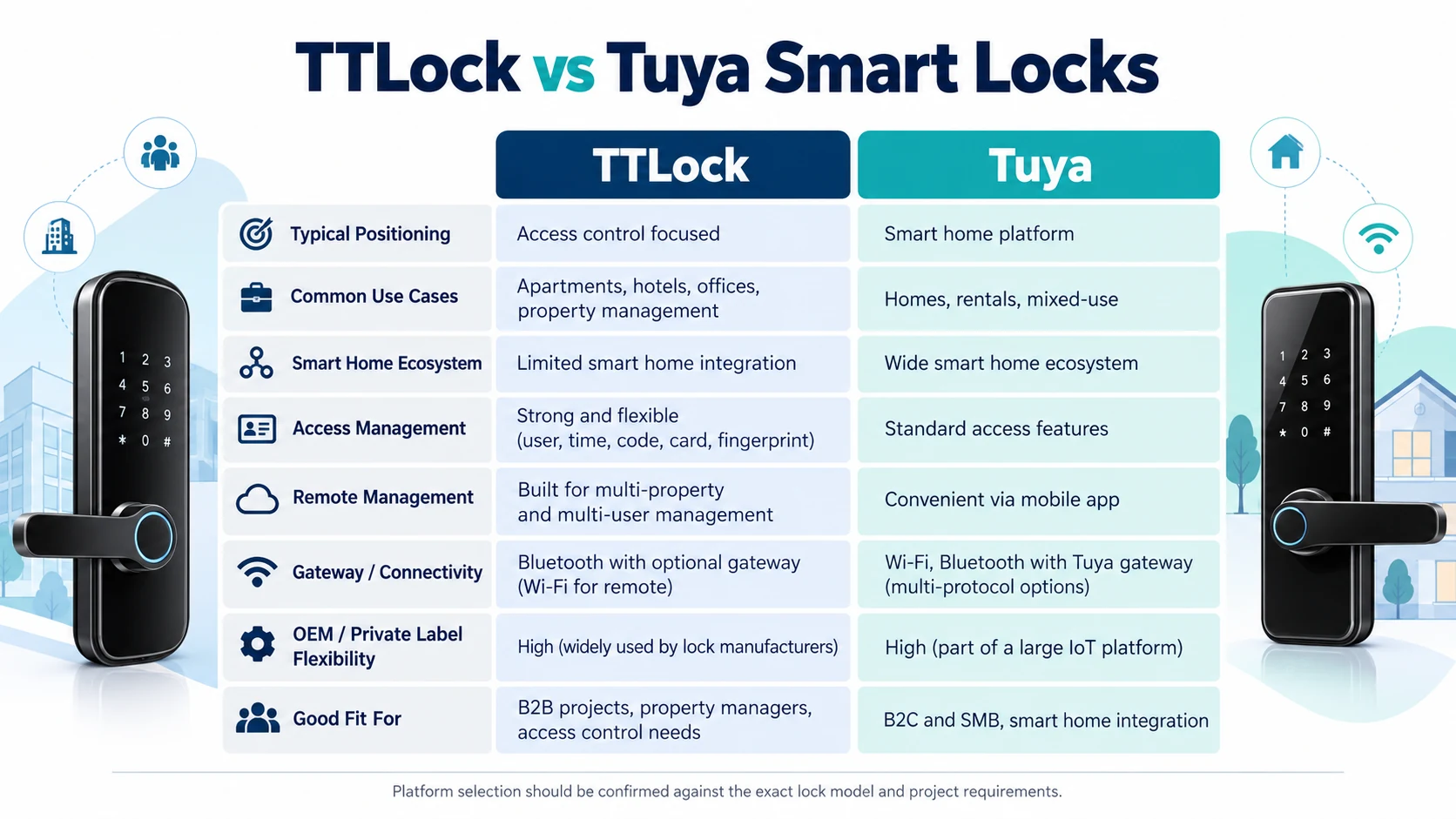
For B2B buyers, the comparison is easiest to understand when the same project questions are applied to both platforms. The table below summarizes eight practical dimensions. These are general purchasing considerations rather than guarantees for every lock: the final feature set must be confirmed against the exact model, firmware, gateway, and project configuration.
| Comparison Dimension | TTLock | Tuya | What Buyers Should Confirm |
|---|---|---|---|
| Typical positioning | Commonly used as a lock- and access-management platform. | Commonly used as part of a broader smart-device and IoT ecosystem. | Whether the project mainly needs access control or wider smart-device integration. |
| Common use cases | Apartments, rentals, offices, property management, and selected hospitality applications. | Homes, rentals, mixed-use projects, and smart-home-oriented applications. | Who will manage the locks, how often users change, and whether other smart devices are part of the project. |
| Smart-home ecosystem | More focused on smart-lock and access workflows; integration options vary by model and solution. | Often selected when broader smart-home or connected-device integration is important. | Which external devices, scenes, or ecosystems the customer expects to use. |
| Access management | Depending on model, may include app users, PINs, cards, fingerprints, access records, and temporary permissions. | Depending on model, may include app users, PINs, cards, fingerprints, and shared or temporary access. | The exact credential types, administrator roles, logs, and permission workflow required. |
| Remote management | Remote functions may require a compatible gateway or network setup, depending on the lock. | Remote functions depend on the selected device connection method and any required hub or gateway. | Whether off-site control, remote code management, or synchronized logs are required. |
| Gateway / connectivity | Bluetooth is common on many TTLock-compatible locks; gateway or other connectivity options vary by model. | Wi-Fi, Bluetooth, and gateway-based configurations are available across different Tuya-compatible devices. | The exact communication method, network environment, gateway requirement, and installation plan. |
| OEM / private-label flexibility | OEM branding, packaging, finishes, and model customization may be available through the lock supplier. | OEM branding and product customization may also be available, depending on supplier, model, and app requirements. | Logo, packaging, app branding, finish, MOQ, certification, and target-market requirements. |
| Good fit for | Buyers prioritizing practical smart-lock access management and project operations. | Buyers wanting the smart lock to participate in a broader connected-device environment. | End-user workflow, project scale, integration expectations, and after-sales capability. |
From a project perspective, TTLock and Tuya are often compared across five areas:
- Access management: user management, temporary passwords, app control, records, and permission sharing.
- Connectivity: Bluetooth, Wi-Fi, gateway requirements, and how remote functions are enabled.
- Ecosystem expectations: whether the buyer mainly needs a lock platform or a broader smart-home environment.
- Project scale: villas, apartments, rental properties, hotels, or mixed-use developments.
- OEM flexibility: branding, packaging, and model matching for local market needs.
In general, TTLock is often chosen for projects that focus on access control and daily lock management. Tuya is often considered by buyers who also value a wider smart-device environment. That said, there is still overlap, and many purchasing decisions come down to the end-user experience the importer or project operator wants to provide.
Connectivity and Remote Management
Many misunderstand the difference between basic app control and full remote management. For both TTLock and Tuya models, buyers should confirm whether the lock works through Bluetooth only, Wi-Fi only, or Bluetooth plus a compatible gateway.
This matters because remote access, log synchronization, and off-site user management may depend on the right gateway or network setup. For apartment operators, serviced rentals, and hotel-style projects, that difference affects both day-to-day convenience and after-sales support.
If your project depends on remote authorization, code sharing, or centralized operation, confirm the platform requirements before choosing hardware. This is also relevant when comparing door environments such as residential smart lock solutions and more specialized door applications like thermally broken aluminum smart locks.
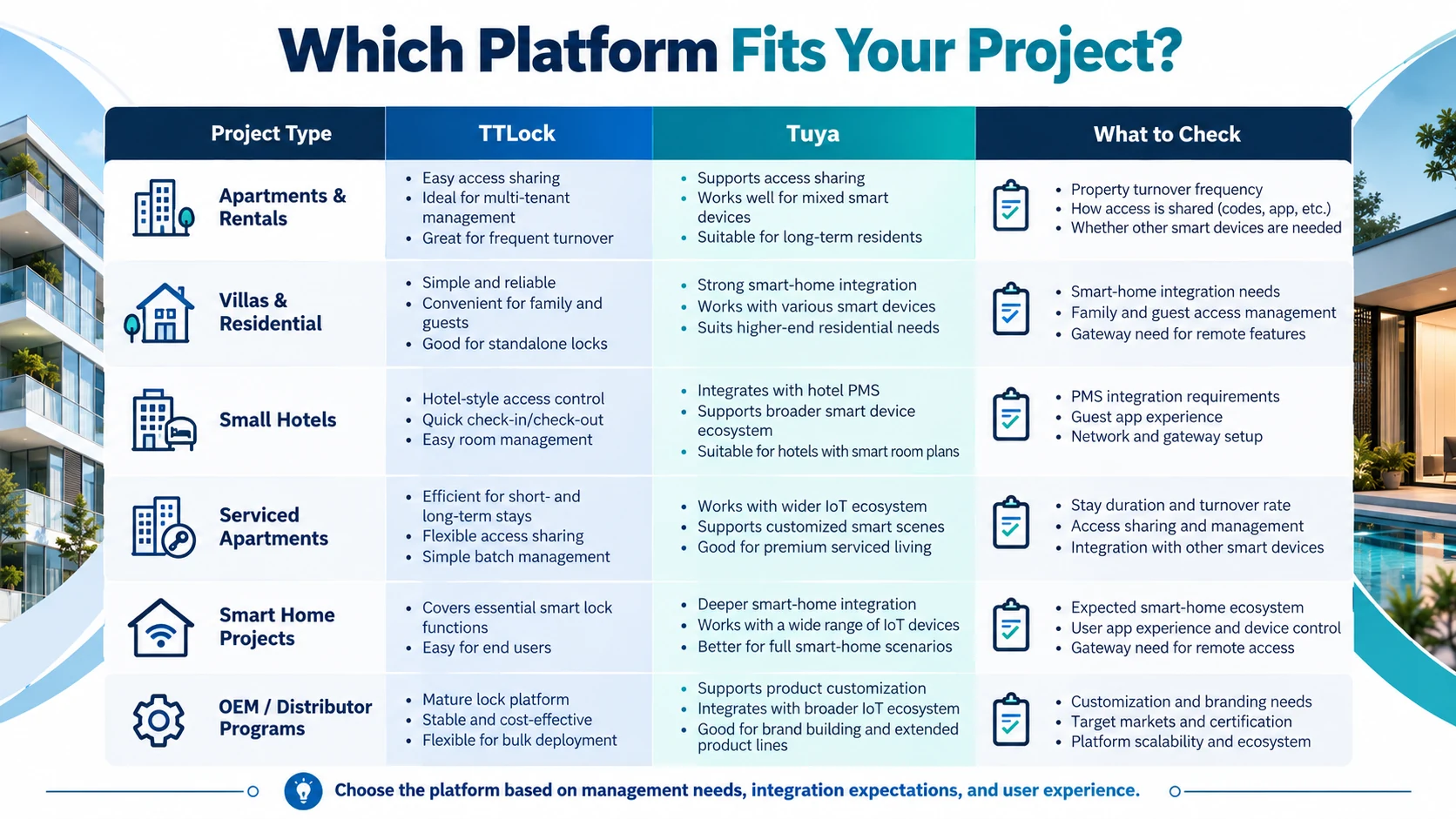
Which Platform Fits Apartments and Rentals?
Apartment and rental projects usually prioritize turnover management, temporary user permissions, and simple access sharing. In this environment, buyers often ask practical questions such as:
- How quickly can new users be added or removed?
- Can the property team issue temporary access for contractors or cleaners?
- Is a gateway needed for remote management across multiple units?
- How easy is the app experience for tenants and property staff?
That is why apartment projects should evaluate the platform together with the lock model, not separately. If you are comparing locks for multi-unit projects, you may also find our related guide useful: Smart Locks for Apartment Buildings: A B2B Selection Guide.
Which Platform Fits Hotels and Serviced Apartments?
Hotels and serviced apartments care about guest access, staff permissions, room turnover, and the operational workflow behind the lock. Some hotel projects also care about software or system compatibility, while others simply want reliable room-level access control.
For this reason, buyers should compare TTLock and Tuya against the actual project workflow: room access, staff management, app expectations, remote support, and whether the customer wants a classic hotel lock setup or a more app-centered smart access experience. Hotel projects can also review our hotel lock solutions page for related product categories and system considerations.
Which Platform Fits Residential Projects?
In residential smart lock projects, the platform choice often depends on how connected the final environment needs to be. Some markets prefer a straightforward lock with app access and sharing features. Others expect stronger smart-home integration and a broader connected-device experience.
Door type also matters. Before choosing TTLock or Tuya, buyers should confirm door material, door thickness, mortise type, backset, and installation dimensions. This is especially important when working across different door categories, such as narrow-frame aluminum doors, standard wooden doors, and security doors.
For importers, a good rule is: confirm the door first, then confirm the platform, then match the final lock model.
OEM and Private-Label Considerations
For importers and distributors, platform choice is only one part of the buying decision. OEM and private-label requirements can be just as important. Buyers should check:
- Whether logo customization is available on the lock body or app
- Whether packaging can be adjusted for the target market
- Whether certain features are available only on specific model variants
- Whether spare parts and after-sales support are available for long-term supply
In other words, two smart locks may both support app control, but they may differ significantly in project suitability once branding, app expectations, or market positioning are included.
What Buyers Should Confirm Before Ordering
Before choosing TTLock or Tuya for a project, buyers should confirm the following:
- Door type and dimensions: aluminum, wooden, or security door; mortise type; thickness; backset; and handle direction where needed.
- Required access methods: PIN, fingerprint, IC card, app, and mechanical key backup.
- Remote management expectations: whether the customer needs off-site management and whether a gateway is acceptable.
- Project scale: apartment, villa, hotel, office, or mixed-use; and the number of doors involved.
- OEM requirements: logo, packaging, finish, or model customization.
- After-sales support: spare parts, technical support, and replacement planning.
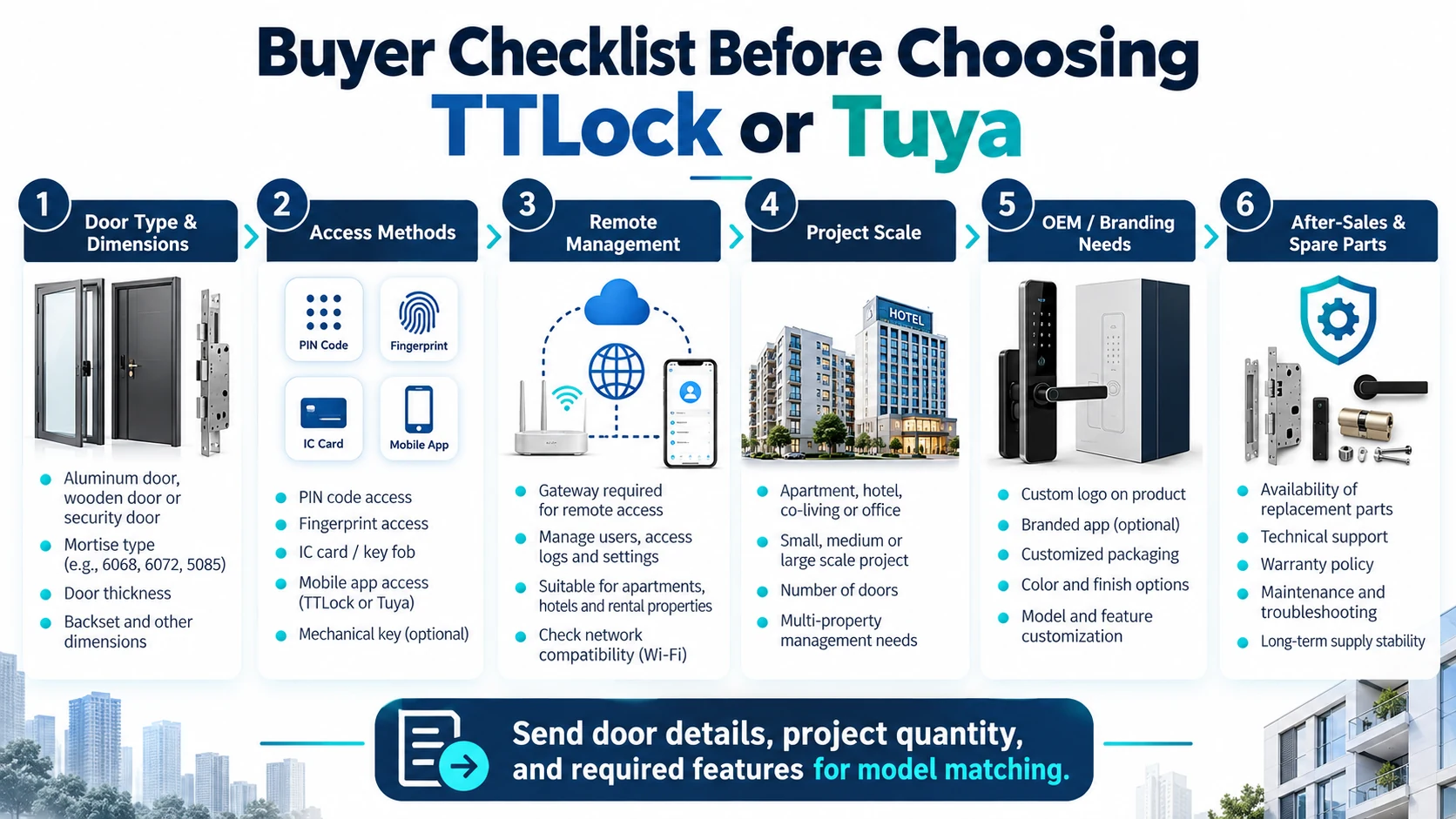
For many buyers, this checklist is more valuable than asking which app platform is more popular. In real purchasing decisions, the right answer depends on the target application, user expectations, and the supplier's ability to match the correct model.
FAQ
Is TTLock better than Tuya for apartments?
Not always. Apartment projects should compare management workflow, remote access requirements, tenant turnover, and the exact lock model before choosing a platform.
Is Tuya better for smart-home integration?
Tuya is often considered when broader smart-home integration is important, but buyers should confirm what the final project actually needs and how the chosen lock model is configured.
Do TTLock and Tuya both support remote management?
Many models can support remote functions, but the final setup may depend on Bluetooth, Wi-Fi, or a compatible gateway. Always verify this with the exact model configuration.
Which platform is better for OEM projects?
That depends on the target market, branding plan, user expectations, and model availability. OEM buyers should evaluate both the app platform and the hardware program together.
What information should buyers send before asking for a recommendation?
Send the door type, door dimensions, project quantity, required access methods, and whether remote management or OEM customization is needed. This helps match the most suitable model more efficiently.
Need Help Matching a Model?
If you are comparing TTLock and Tuya for an apartment, hotel, residential, or OEM project, send us your door details, project quantity, target access methods, and branding requirements through our contact page. We can recommend suitable models based on your application and door conditions.