smartlockmarket.com

Smart Lock Spare Parts for Distributors: Inventory, Warranty & Replacement Costs
For smart lock importers, door-hardware wholesalers and distributors
A smart lock distributor should plan spare parts before the first bulk shipment reaches local customers. The most useful system is simple: identify replaceable components by exact lock version, keep only an approved starter stock, calculate replenishment from actual service use, and document every warranty claim. That reduces avoidable stock, incorrect replacement shipments and time spent troubleshooting.
SmartLockMarket's warranty period is one year, and customers pay shipping costs associated with warranty service. This article focuses on inventory, replacement costs and claim handling rather than repeating the company's general warranty and ordering FAQs. The applicable coverage, start date, exclusions and remedies should be documented in the sales agreement; the warranty statement does not, by itself, promise free parts or specific replacements.

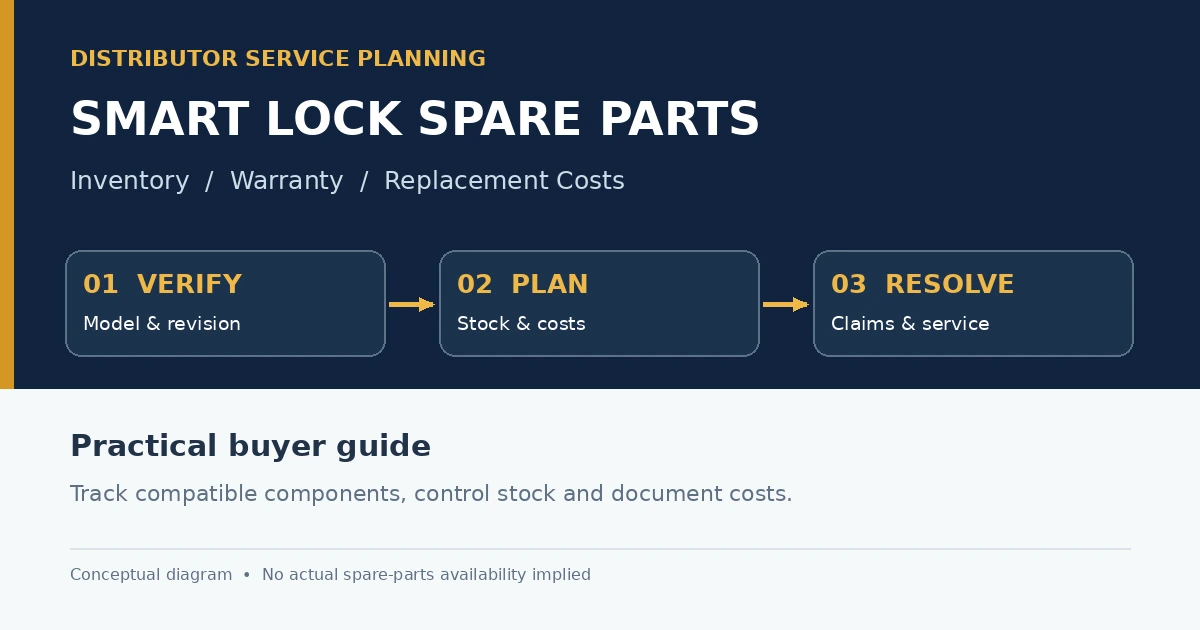
Illustrative service-planning diagram; not a photograph of SmartLockMarket products or an offer of separately available components.
Table of Contents
Which smart lock spare parts should distributors stock?
Answer: start with the components that your supplier confirms are separately replaceable for the exact purchased version. Stocking generic “smart lock PCB” units without matching part codes is more likely to create unusable inventory than reliable after-sales support.
| Potential service part | When it might be needed | Information to record before ordering |
|---|---|---|
| Control PCB or reader assembly | Confirmed electronic failure | Board identifier, hardware revision, firmware constraints, connector position and approved repair method |
| Lock body / mortise | Confirmed mechanical damage or wear | Backset, center distance, faceplate size, spindle and fixing-hole drawing |
| Handle or panel assembly | Physical damage or a confirmed assembly fault | Left/right handing, finish, model version and approved assembly code |
| Cable and connector set | Damaged or disconnected wiring | Cable length, pin arrangement, connector keying and qualified installation method |
| Emergency-access component, if fitted | Approved recovery or repair | Exact override configuration and safe replacement method |
This is a buyer's checklist, not a promise that every SmartLockMarket model has every component available for individual sale. Keep consumable batteries and routine installation accessories in separate inventory categories. Do not authorize repairs that could affect the door's emergency exit or fire-rated status without the appropriate qualified installer.
How do buyers prevent incompatible replacement parts?
Answer: use a model-and-version-specific spare-parts SKU. A similar product name or a shared mortise family does not prove that boards, wiring, handles or lock bodies can be swapped.
For example, the publicly described configurations of two fingerprint door lock models differ:
| Product page | Listed electronic board | Listed standard lock body |
|---|---|---|
| 2017-S10 fingerprint/keypad lock | 8503 voice-enabled board | Security 6068 |
| RX2067 fingerprint/keypad lock | 8534 voice-enabled board | Security 6068 |
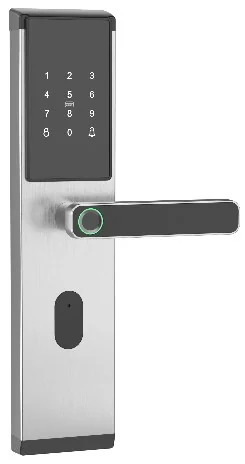
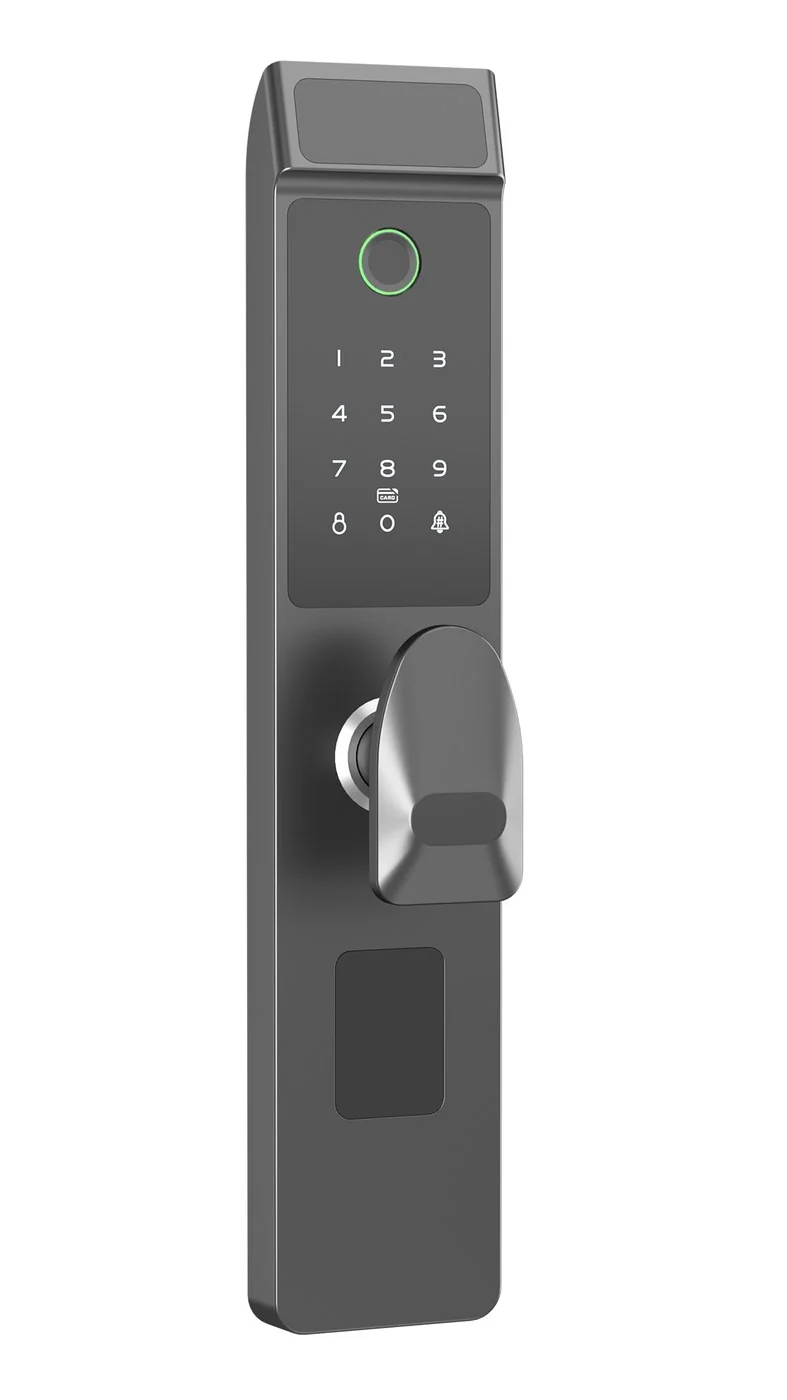
These are published product configurations, not a guarantee that those boards are currently supplied as spares. The 6068 designation also does not guarantee direct interchangeability: compare the full mechanical drawings and exact quoted revision.
For every proposed spare part, record lock model / original board or mortise code / production revision / approved replacement part / test result. A distributor should approve a part for stock only after a representative sample has been fitted and tested using the authorized installation procedure. A part fails acceptance if required unlocking methods, latching or approved recovery steps do not work.
How many spare parts should a first shipment include?
Answer: there is no trustworthy universal “2% of locks” rule. For a new distributor, agree on a small starter service kit of confirmed parts, then calculate future replenishment using your actual service records and the supplier's confirmed lead time. Do not mistake example service quantities for predicted product failure rates.
Once you have recorded usage, calculate the inventory reorder point:
Reorder point = average weekly part usage × replenishment lead time in weeks + safety stock.
Suppose your local team actually observes an average usage of one approved board per week, the agreed replenishment lead time is four weeks, and you choose to keep two boards as safety stock. The reorder point is 1 × 4 + 2 = 6 boards. When stock reaches six, trigger replenishment. These are illustrative inputs, not measured SmartLockMarket failure data or an actual supplier lead time. The formula follows established inventory-planning practice (Oracle NetSuite).
A new buyer without history should use a trial service kit and update the reorder point once real usage is available. Reserve more only where a verified service need, downtime cost and compatible stock justify it. Track this separately for each hardware version.
How much does after-sales service cost?
Answer: include spare-parts stock, warranty-related freight, local technician time and handling costs—not only the original lock price. SmartLockMarket's one-year warranty does not remove those operating costs; under the confirmed policy, customers are responsible for warranty-service shipping costs.
Service-budget formula:
Budget = spare-parts purchases + freight + local labour + testing and handling − approved credits or reimbursements
Worked example: a hypothetical 500-lock distributor launch
This entire example is for learning the calculation. None of the figures is a SmartLockMarket quotation, actual failure rate, required spare quantity, freight estimate or warranty decision.
| Expense | Illustrative quantity or allowance | Calculated amount |
|---|---|---|
| Electronic boards | 6 × $8 | $48 |
| Lock bodies | 3 × $12 | $36 |
| Handle assemblies | 2 × $15 | $30 |
| Consolidated service-stock freight | Assumed | $45 |
| Local diagnostics and labour reserve | Assumed | $60 |
| Total hypothetical service budget | $219 |
$219 ÷ 500 locks = $0.438, rounded to $0.44 per lock for this example. This is a planning allocation, not a warranty charge or defect forecast. Change the quantities, costs and local labour assumptions to your own confirmed quotations.
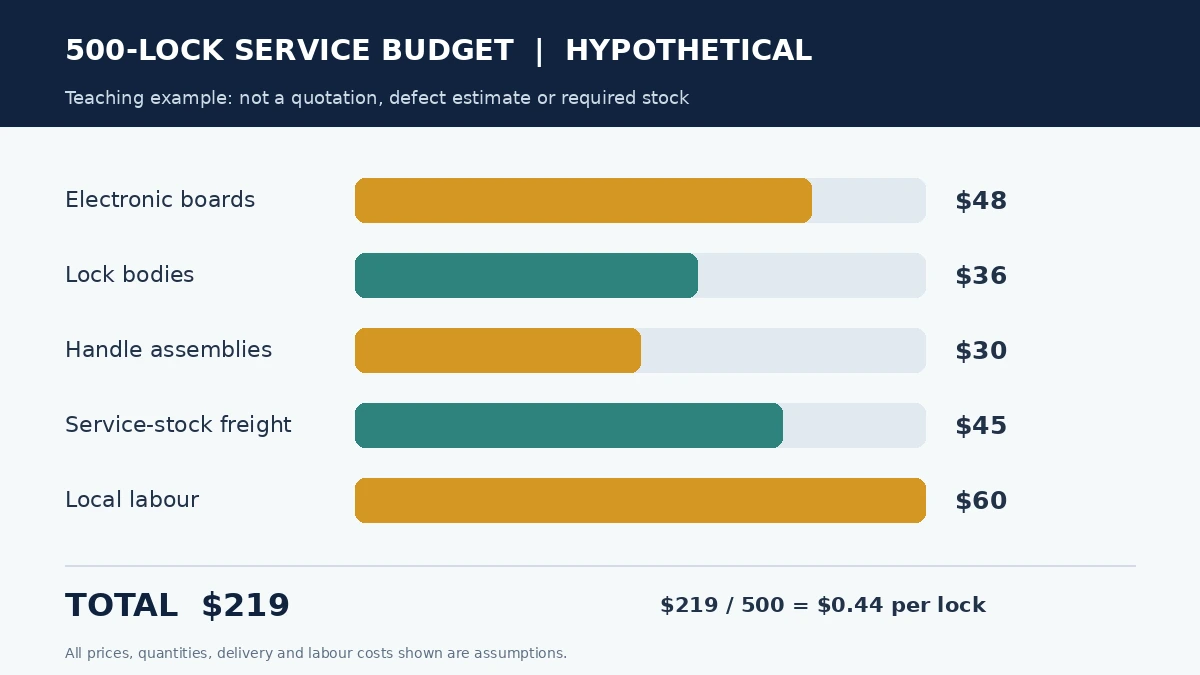
Hypothetical budget example only; values are not company prices or actual failure statistics.
Shipping decision: Consolidate routine spare-parts replenishment when doing so reduces cost without violating customer service commitments. For a site-critical failure, assess the safety issue and required resolution deadline first; an urgent shipment can be justified even when freight is higher. Tell your own end customers how local technician fees and shipping charges are handled rather than implying the factory's one-year warranty automatically pays those costs.
What is the correct warranty claim workflow?
Answer: identify the unit, perform safe first-line checks, collect evidence, obtain the documented claim decision, and close the ticket with the real service cost. Do not ship a replacement board or an entire lock before compatibility and the appropriate remedy are established.
| Step | Action | Evidence or outcome |
|---|---|---|
| 1. Identify | Log sales order, model, version, serial/batch identifier (if present), installation date and issue | Unique service ticket |
| 2. Triage | Check batteries, documented configuration and visible installation conditions using approved procedures | Fault category; safety issues escalated |
| 3. Document | Collect photos, short issue video, error description, version labels and test notes | Evidence set without passwords, PINs or unnecessary personal data |
| 4. Decide | Send the evidence for assessment; record the approved repair, spare or other remedy | Written decision and shipping responsibility |
| 5. Close | Apply the approved remedy, record time, parts used, freight and test result | Closed ticket and usable service-cost history |
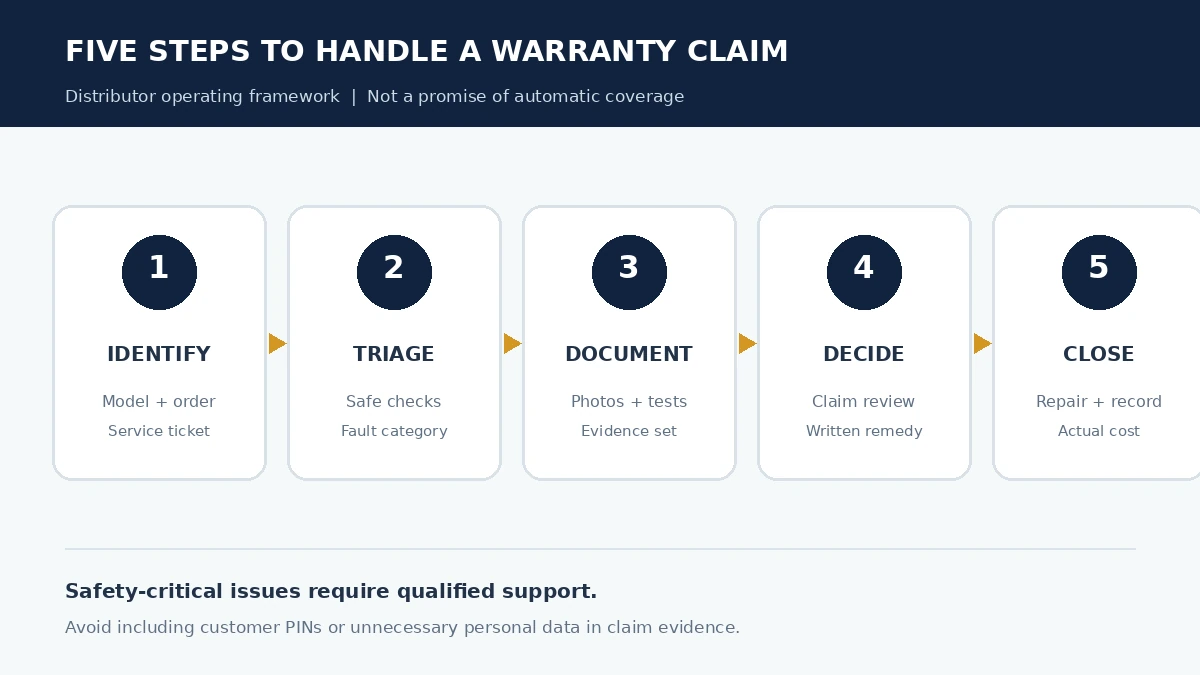
General distributor workflow; individual warranty remedies depend on the applicable sales agreement.
Differentiate confirmed manufacturing faults from installation errors, discharged batteries and unsupported configurations. This prevents unnecessary cross-border shipments and helps purchasing staff find repeated issues related to a specific batch or revision.
What should an importer put on the next purchase order?
Answer: add two appendices: a version-controlled spare-parts schedule and a service-handling sheet. A general statement such as “spares available” does not identify what your local team may order or install.
| Purchase-order attachment | Minimum fields to agree in writing |
|---|---|
| Spare-parts schedule | Lock model and revision; part number and approved compatibility; quantity; unit price; packaging; replenishment lead time; replacement documentation |
| Service-handling sheet | One-year warranty; coverage commencement basis, excluded conditions and remedy as agreed; customer-paid warranty freight; evidence required; claim contact and escalation path |
This approach gives staff an exact parts list and a claim process instead of relying on generic catalogue descriptions. Order quantities and availability remain model-specific until confirmed in the quotation or pro forma invoice.
A shipping term such as EXW or FOB does not settle warranty remedies. The International Chamber of Commerce's Incoterms® guidance explicitly distinguishes the delivery/risk rules from remedies under the contract of sale. Record the warranty-service freight arrangement separately.
Which after-sales numbers matter each month?
Answer: track just four metrics at first, and examine them by model and production revision:
| Metric | How to calculate it | What it tells the buyer |
|---|---|---|
| Tickets per model | Tickets ÷ units sold during the same defined period | Which products need further review |
| Approved claims rate | Approved warranty claims ÷ claims submitted | How many submitted cases meet the agreed warranty terms |
| Mean resolution time | Total ticket open-to-close days ÷ tickets closed | Whether parts availability or service workflow delays closure |
| Recorded service cost per lock sold | Recorded service spend ÷ units sold in the period | Impact on margin; review timing and repeat-claim effects |
Label tickets correctly: an installation mistake is not automatically a manufacturing defect. Small batches should not be described as statistically reliable failure-rate evidence.
Build a supportable smart lock product line
For distributors, a low unit price is only useful if parts can be identified, service costs measured and claims processed without avoidable delays. The best initial action is to request a model-specific spare-parts schedule, not to order a percentage of unverified replacement boards.
Send SmartLockMarket your target lock models, quantity, destination market and local service arrangement. We can review the requested configuration and confirm which spare parts, prices and supply conditions can be included in your quotation. Explore the fingerprint smart lock range or read the first-order wholesale buying guide if you are still choosing an opening assortment.
Editorial notes: all calculated prices, quantities, shipping and labour inputs in this article are hypothetical teaching examples. The one-year warranty and customer-paid warranty-service shipping policy were confirmed by SmartLockMarket management. Exact coverage and remedies belong in the agreed commercial documents; product configurations described here are based on published pages and must be checked against the current quoted version.