smartlockmarket.com

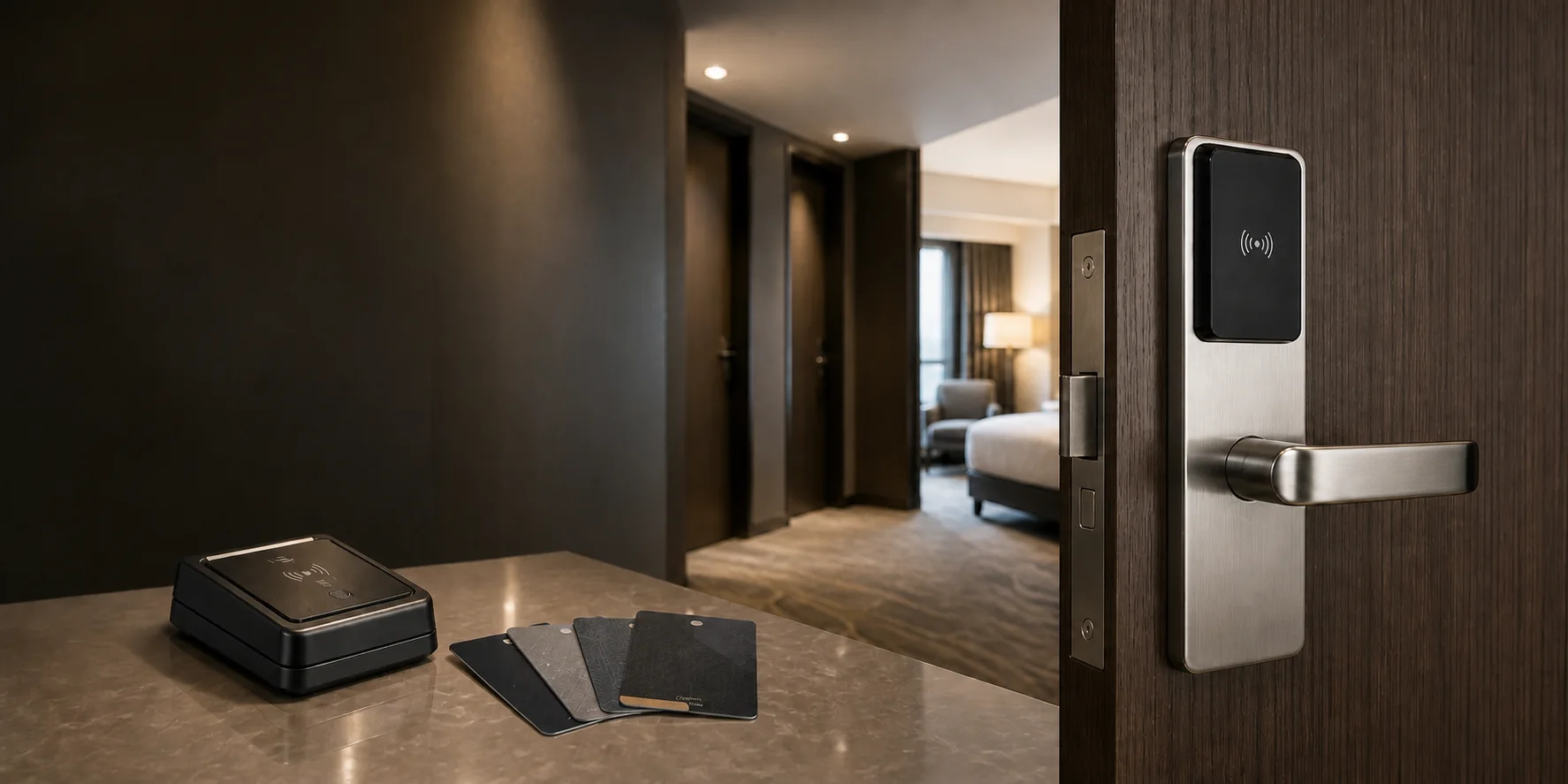
Hotel RFID Locks: Complete Buying Guide for Hotels, Distributors & Project Buyers
Hotel RFID locks—also called hotel RFID door locks or hotel card locks—manage guest-room access with contactless card entry. A reliable system must fit the door hardware, the front-desk card-issuing workflow, the management software, and the project's supply requirements, not just the look of the lock.
This guide is written for hotel owners, developers, distributors, importers, project buyers, and OEM/ODM customers comparing systems for guest rooms, resorts, serviced apartments, and renovation programs. It covers the main lock types, how to compare RFID cards and encoders, the key specifications to check, and how to qualify a hotel lock supplier before bulk ordering.
For buyers looking for a reliable hotel RFID lock supplier, SmartLockMarket provides systems to distributors, hospitality projects, and OEM customers, supporting standard models, customization, and project-based supply. Browse our Hotel RFID Locks or review our Hotel Lock Solutions for project planning.
Editorial note: Compatibility, software, card technology, mobile access, and customization vary by model. Confirm the final configuration with drawings, samples, and project requirements before bulk ordering.
1. What a Complete Hotel RFID Lock System Includes
A complete hotel RFID lock system is more than the lock on the guest-room door. Each component must work together, so confirm the full bill of materials before comparing supplier quotations.
- RFID Hotel Door Lock: the lock body, RFID reader, handle, battery compartment, mechanical key override and mounting hardware.
- RFID Card: guest cards, staff cards, master cards and replacement cards with different access levels.
- Card Encoder: the front-desk device that writes and expires guest access credentials.
- Hotel Lock Management Software: creates, expires and revokes guest and staff access and logs events.
- Energy Saving Switch: helps control room power when a guest card is inserted, subject to the project wiring and room-energy design.
- Gateway (Optional): enables remote or online management on supported hotel RFID lock system models.
For high-turnover hotels, check-in, replacement-card issuing, checkout expiry, and staff permissions should all be fast to operate. For distributors and project buyers, the quotation should also name spare parts, installation support, training, and long-term supply responsibility. Hotel projects purchase a complete access-control workflow, not only a door lock.
Explore our Hotel RFID Locks collection, including the 118E-S/S1 RFID Hotel Door Lock and the 2037E RFID Hotel Door Lock.
2. Hotel RFID Lock Types
Hotel RFID locks are commonly available in several configurations. Match the lock type to the door condition, access workflow, and project scope before selecting a model.
RFID Mortise Hotel Locks
Designed for standard guest-room doors.
- RFID card access
- Mechanical override
- Battery-powered operation
RFID Hotel Locks with Mobile Access
For projects requiring remote or phone-based unlocking.
- Bluetooth unlocking
- Mobile app access
- Gateway management
RFID Locks for Renovation Projects
Designed for replacing existing hotel locks with minimum modification.
3. Hotel RFID Lock Applications
The right hotel RFID door lock depends on the property type, door condition, access workflow, and the level of centralized management required.
Hotels
- Guest-room access with time-limited RFID cards
- Front-desk card issuing and replacement-card workflow
- Separate staff management for housekeeping, engineering, and supervisors
- Mechanical override and emergency access procedures
Resorts
- Multiple buildings, villas, or guest-room blocks
- Centralized or property-level management depending on the project
- Consistent lock finish, cards, spare parts, and operating procedures across buildings
- Coordination between room access, staff access, and common-area requirements
Serviced Apartments
- Long-term rental and extended-stay access
- Flexible guest, tenant, staff, and maintenance permissions
- RFID card access with optional password or mobile options
- Clear expiry and replacement procedures when occupants or staff change
Renovation Projects
- Replacement of existing hotel locks with minimum door modification
- Verification of door material, thickness, handing, mortise, and latch dimensions
- Sample installation before confirming the bulk order
- Reuse or replacement planning for cards, encoders, software, and spare parts
4. RFID Cards, Encoders, and Management Systems
A hotel door lock system should be evaluated as one operating workflow. Buyers should confirm the following components and responsibilities in the quotation.
| Component | What Buyers Should Confirm |
|---|---|
| RFID Door Lock | Mortise, door thickness, finish, battery, mechanical override, and installation method |
| RFID Card | Frequency, card type, card format, compatibility, replacement process, and supply |
| Card Encoder | Software, connection, driver, issuing process, PMS compatibility, and offline procedure |
| Management System | Offline or online management, user roles, card expiry, revoke process, and reporting |
| Spare Parts | Battery, lock body, handle, reader, mortise, card, encoder, and long-term availability |
RFID Card Types for Hotel Locks
| Card Type | Frequency | Security Level | Typical Application |
|---|---|---|---|
| MIFARE Classic | 13.56 MHz | Standard | Common hotel key card lock and guest-room access projects |
| MIFARE DESFire | 13.56 MHz | Higher | Projects needing stronger credential security or more controlled access |
| EM Card | 125 kHz | Basic | Legacy or budget systems where simple proximity access is sufficient |
For a MIFARE hotel lock, confirm whether the model supports MIFARE Classic or MIFARE DESFire, and verify the card encoder and hotel management software before ordering.
Most modern hotel locks read 13.56 MHz high-frequency (HF) cards such as MIFARE Classic 1K/4K, MIFARE Plus, or MIFARE DESFire. Older or budget systems may still use 125 kHz low-frequency (LF) formats such as EM4100 or T5577. Always match the lock, cards, and encoder to the same frequency and format—mixing them is a common cause of failed commissioning.
Some projects also require mobile access, Bluetooth, gateways, or a platform such as TTLock. Treat these as model-specific requirements. Confirm the exact lock, app, gateway, software, and operating process instead of assuming that every hotel RFID lock supports the same functions.
5. Key Specifications to Compare
Compare these specifications across suppliers to spot quality and compatibility gaps that are easy to miss in marketing photos.
| Specification | What to Check | Common Examples |
|---|---|---|
| RFID frequency | Lock reader must match the card and encoder | 13.56 MHz (HF) or 125 kHz (LF) |
| Card format | Supported MIFARE or LF card standard | MIFARE Classic / Plus / DESFire, EM4100, T5577 |
| Battery | Type, count, life, and low-power alert | 4×AA alkaline, ~12–18 months |
| Emergency power | External port when the battery is dead | Micro-USB or 9V backup |
| Mechanical override | Key cylinder for emergency access | Included on most models |
| Mortise & door fit | Door thickness, handing, latch, backset | EU/US mortise, 35–50 mm door |
| Finish & IP rating | Corrosion resistance for indoor or coastal use | Typically IP54 or higher |
Examples are for reference and vary by model. Use them to structure supplier questions, then confirm exact values against the product drawing and sample.
6. How to Select the Right Hotel RFID Door Lock
Use this procurement sequence to reduce compatibility problems and avoid selecting a lock only from photos or a generic specification sheet.
- Confirm door information: document the door material, thickness, handing, mortise, latch, fire-rating requirements, and installation condition.
- Select the access method: decide whether the project needs RFID cards, staff cards, mobile access, Bluetooth, mechanical override, or a supported combination.
- Confirm system compatibility: verify the management software, card encoder, gateway, platform, user roles, card expiry, and emergency procedure.
- Test samples before bulk order: install a sample on a representative door and test fit, card operation, issuing, access permissions, battery replacement, and installation requirements.
For a multi-building hotel or renovation project, also confirm finish consistency, spare-part planning, installation training, packaging, lead time, and the process for handling defects or replacements.
7. OEM, Wholesale, and Project Supply
For distributors and project buyers, a suitable hotel door lock manufacturer, hotel locks supplier, or hotel RFID lock supplier should support the complete purchasing process—not only provide a product link.
Before placing a bulk order, ask the supplier to provide:
- Product drawings and technical specifications
- Installation manuals and sample installation support
- Sample testing for doors, cards, encoders, and software
- Logo customization and packaging customization options
- Spare-parts support and long-term supply availability
- Stable production capacity, lead time, MOQ, and quality-control process
- Warranty terms, training, and after-sales project support
OEM/ODM requirements may include logo, packaging, appearance, finish, card design, software workflow, or project-specific hardware. Availability depends on the model and order quantity, so confirm each requirement in writing before production.
Learn more about OEM/ODM smart lock supply: OEM Smart Lock Solutions.
8. How to Choose a Reliable Hotel RFID Lock Supplier
A reliable hotel RFID lock manufacturer or supplier should help you validate the door hardware, system workflow and long-term operating cost before production. Use the following checks when comparing a hotel RFID lock supplier or a hotel door lock supplier in China.
- Factory experience: check how long the supplier has worked in hotel access control, which markets it serves, and whether it can provide references for comparable hospitality projects.
- Production capability: confirm capacity, quality-control checkpoints, lead time, MOQ, packaging process and the ability to keep the same specifications across repeat orders.
- OEM/ODM customization: ask whether logo, finish, appearance, card design, packaging, firmware or software workflow can be adapted to your brand and project.
- Certification support: request applicable CE, FCC, RoHS, fire-rating or local compliance documents and confirm that the reports match the final model and configuration.
- Software compatibility: test the hotel RFID lock system with the proposed encoder, management software, PMS or gateway before committing to a rollout.
- Sample testing: install and operate samples on representative doors, then test cards, issuing, expiry, staff permissions, emergency access and battery replacement.
- Spare parts availability: confirm ongoing access to lock bodies, mortises, handles, readers, batteries, cards, encoders and other replacement components.
- After-sales support: clarify installation guidance, training, warranty handling, remote troubleshooting, replacement procedures and response times for project issues.
SmartLockMarket brings 23+ years of smart lock industry experience and provides OEM and ODM services for distributors, importers, contractors and hospitality brands. Project-based supply is available, and small trial orders are available for evaluation before a larger rollout.
9. Frequently Asked Questions
What is an RFID hotel lock?
An RFID hotel lock is an electronic RFID hotel door lock that reads a contactless card or key fob and grants access according to credentials issued by the hotel lock management system.
Are RFID hotel locks secure?
RFID hotel locks can provide secure, time-limited and role-based access when the lock, card technology, encoder and software are configured correctly. Buyers should also confirm mechanical override, audit logs and emergency procedures.
What cards are used for hotel RFID locks?
Common options include 13.56 MHz MIFARE Classic and MIFARE DESFire cards. Some legacy or budget systems use 125 kHz EM cards. The lock, card and encoder must use the same frequency and card format.
Can RFID hotel locks work with hotel management software?
Yes, when the selected lock, card encoder and software are designed to work together. Confirm the software workflow, user roles, card expiry, event records, PMS or gateway compatibility and offline operation before ordering.
How to choose a hotel RFID lock supplier?
Compare factory experience, production capability, OEM/ODM support, certifications, software compatibility, sample testing, spare-parts availability and after-sales support. Project buyers should also confirm lead time, MOQ and long-term supply responsibility.
10. Need Hotel RFID Locks for Your Project?
SmartLockMarket supplies RFID hotel lock systems for hotels, resorts, distributors and OEM brands.
Contact us for samples, customization and project cooperation.