smartlockmarket.com

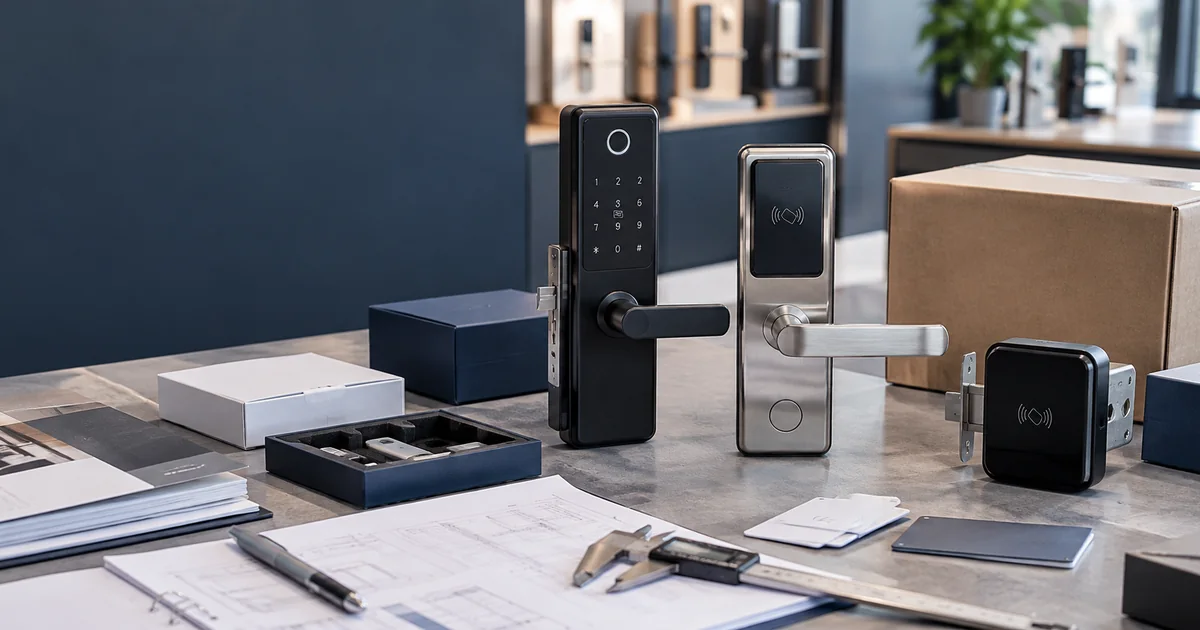
Wholesale Smart Locks from China: A Distributor's First Order Checklist
Buying wholesale smart locks from China is not only a price comparison. For a local distributor or importer, the first order creates a product line that must fit local doors, work with the expected access method, survive installation, and be supported when a customer calls months later.
A low unit price does not solve a wrong mortise, an unsupported app version, missing spare components or an unclear warranty process. Your first shipment should therefore be designed as a controlled market test: a small, supportable selection of models, approved samples, written configurations and a realistic landed-cost calculation.
This guide is written for smart lock distributors, security hardware wholesalers, door-hardware dealers, importers and private-label resellers. It focuses on decisions that influence sell-through, returns and replenishment—not just how to submit a general OEM/ODM request.
Buyer note: Smart lock features, minimum order quantities (MOQ), sample pricing, branding, certifications, stock, shipping terms and lead times depend on the exact model, configuration and destination. Confirm them with the supplier before ordering. The suggestions below are a purchasing framework, not fixed SmartLockMarket commercial terms.
Table of Contents
What Makes a Distributor's First Smart Lock Order Different?
An end customer usually asks whether a smart lock can open one door. A distributor must answer a bigger set of questions: Which doors in my market does it fit? Can my installer explain it? Who handles customer setup? What do I send for a warranty claim? Can I purchase the same configuration again?
Think about the complete journey from quotation to the second order. One of the most expensive mistakes is building a catalogue around attractive product photographs before confirming how those products will be installed, supported and replenished locally.
A useful first-order plan should define the target customer, primary door applications, required access methods, sales channel, planned sample tests, expected first-order quantity and what will count as a successful pilot. A distributor supplying door shops may need different lock bodies and documentation from a reseller serving serviced apartments or a wholesaler supplying access-control installers.
Before comparing suppliers, write a one-page market brief. It will make discussions about prices, model suitability and after-sales responsibilities much more productive.
Build a Small Product Mix for Your Local Customers
New importers often ask for the full catalogue. A large catalogue is useful for market research, but a large opening order can turn into slow-moving inventory. Instead, choose a limited number of candidate SKUs with different jobs: for example, a residential fingerprint lock, a straightforward keypad option and a specialist commercial model only if your customer network already needs it.
Begin with the real doors your customers use. A model suited to a metal security door may not fit an interior wooden door or a narrow aluminum profile. Even within one country, installers may encounter different door preparations and mortise dimensions.
| Target customer | Candidate product line | What to verify before stocking | Stocking caution |
|---|---|---|---|
| Homeowners and door shops | Fingerprint / keypad smart door locks | Door material, thickness, handing, mortise, local app expectations | A popular-looking lock may not fit common local doors |
| Apartment managers | Selected code- or app-managed locks | User provisioning, permission changes, connectivity and support workflow | Management features vary by model and platform |
| Hotels and resorts | RFID hotel lock system | Lock, credentials, encoder, management software and door fit | A standalone lock price may exclude the system components |
| Gyms, spas and locker suppliers | RFID / keypad locker locks | Cabinet material, door thickness, operating mode and credentials | Locker installation is not the same as residential door installation |
Explore the relevant product families before creating a shortlist: fingerprint door locks, hotel RFID locks and RFID locker locks. These are product categories, not a claim that every model supports every market or use case.
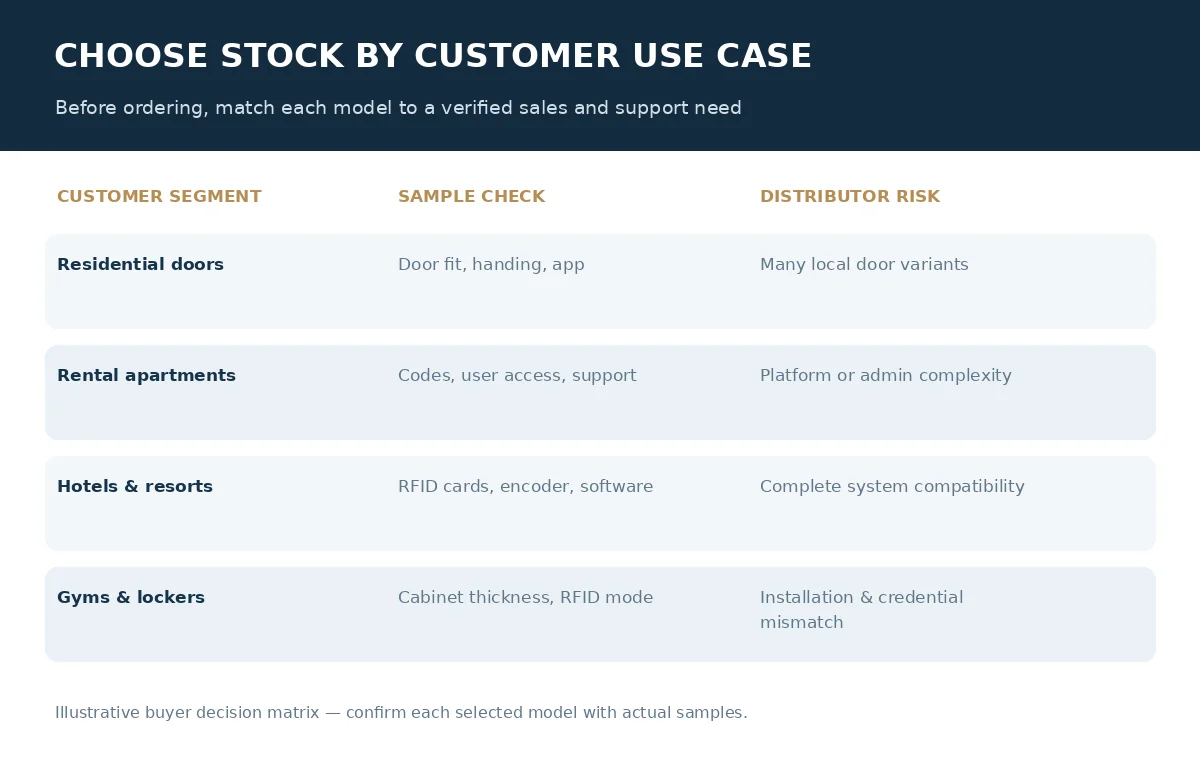
For a first shipment, your goal is not the widest catalogue. It is to learn which limited selection can be demonstrated, installed correctly, sold repeatedly and restocked without unexpected changes.
Check Door Fit, Software and Market Requirements
Compatibility is a distributor's after-sales issue before it becomes an installer's issue. Request the dimensional drawing and supported door specification for each candidate lock. Record door thickness, material, handing, backset, center distance where relevant, cut-out and mortise type. Ask for actual installation instructions rather than assuming similar-looking models use the same lock body.
Next, verify the electronic configuration. Fingerprint, keypad, RFID, mechanical-key backup, Bluetooth, Wi-Fi gateway and mobile app functions should be listed separately. The presence of an app name on another model does not establish support on the selected SKU. If the distributor plans to offer TTLock or Tuya variants, confirm the exact hardware/firmware version, account or gateway requirements, and who supports setup and troubleshooting.
Use a named model as a starting point—not a shortcut to assumptions. The RX-MJ01 fingerprint lock product page, for example, identifies the platform and panel size but directs buyers to confirm door fit and related configuration details. That is the kind of remaining specification question a buyer should close before approval.
Finally, identify compliance and documentation requirements for the destination market. A document marked CE or FCC cannot automatically be applied to every lock, radio module or variant. Request evidence traceable to the product you will actually import; use our FCC, CE and RoHS buyer-verification guide for the distinction, then confirm obligations with a qualified local adviser or importer of record. Do not assume that one certificate covers every national market.
Ask Suppliers for Comparable Wholesale Quotations
A supplier's lowest advertised price rarely tells you the full cost of a distributor-ready unit. Send every shortlisted supplier the same request, specifying the destination country and intended channel. Compare equivalent configurations: the same access method, mortise, power arrangement, finish, packaging, accessories, app/platform and service scope.
| Quotation field | Why a distributor needs it | Question to ask |
|---|---|---|
| Model and configuration | Prevents mixing incompatible versions | Which board, firmware, mortise, color and access methods are included? |
| Sample and pilot quantities | Controls market-testing risk | Are samples and mixed-SKU trial orders available? At what terms? |
| MOQ by SKU and by customization | Determines how much stock must be committed | Does the MOQ change for a logo, carton, label or special finish? |
| Unit price and price tiers | Supports distributor margin planning | Is the tier applied per SKU, per order or per configuration? |
| Packaging and accessories | Affects retail readiness and returns | Are batteries, keys, mortise, screws, manual and gateway included or extra? |
| Incoterm and named place | Allocates freight, clearance and risk responsibilities | Is it EXW, FOB, FCA or another agreed term and named location? |
| Lead time and stock status | Controls replenishment promises | When does the clock start—deposit, sample approval or artwork approval? |
| Warranty and spare parts | Determines local service cost | What proof, replacement method, component access and claim window apply? |
Do not assume one factory's quoted MOQ applies to all models or that the same MOQ applies to private label. If logo, carton or software requirements move beyond standard stock, confirm the revised MOQ, artwork approval, tooling or setup charges and production schedule in writing. The separate OEM vs ODM guide explains customization depth; this article focuses on how a distributor makes a practical first purchasing decision.
Plan Samples and a Controlled First Order
A first order should follow approval gates. Start with representative samples, preferably tested on doors and with the same app and accessories that your customers will use. One sample functioning on a showroom table is useful but does not confirm suitability for every door variant sold in your market.
| Gate | Buyer evidence | Decision before moving forward |
|---|---|---|
| Market brief | Target customers, local doors, planned channel, price position | Are the candidate SKUs relevant? |
| Sample received | Labelled models, included accessories, drawings, software versions | Is the sample the quoted configuration? |
| Installation test | Photos, door measurements, installer feedback, failure notes | Can an installer support the product? |
| Functional test | Unlocking, setup, battery behavior, emergency access, app workflow | Do the promised functions work on the tested version? |
| Written approval | Approved sample reference, specification, packaging, service scope | Can this exact version enter the pilot order? |
| Pilot shipment | Inspection record, cartons, documentation and received-stock check | Is sell-through and customer support ready for the next order? |
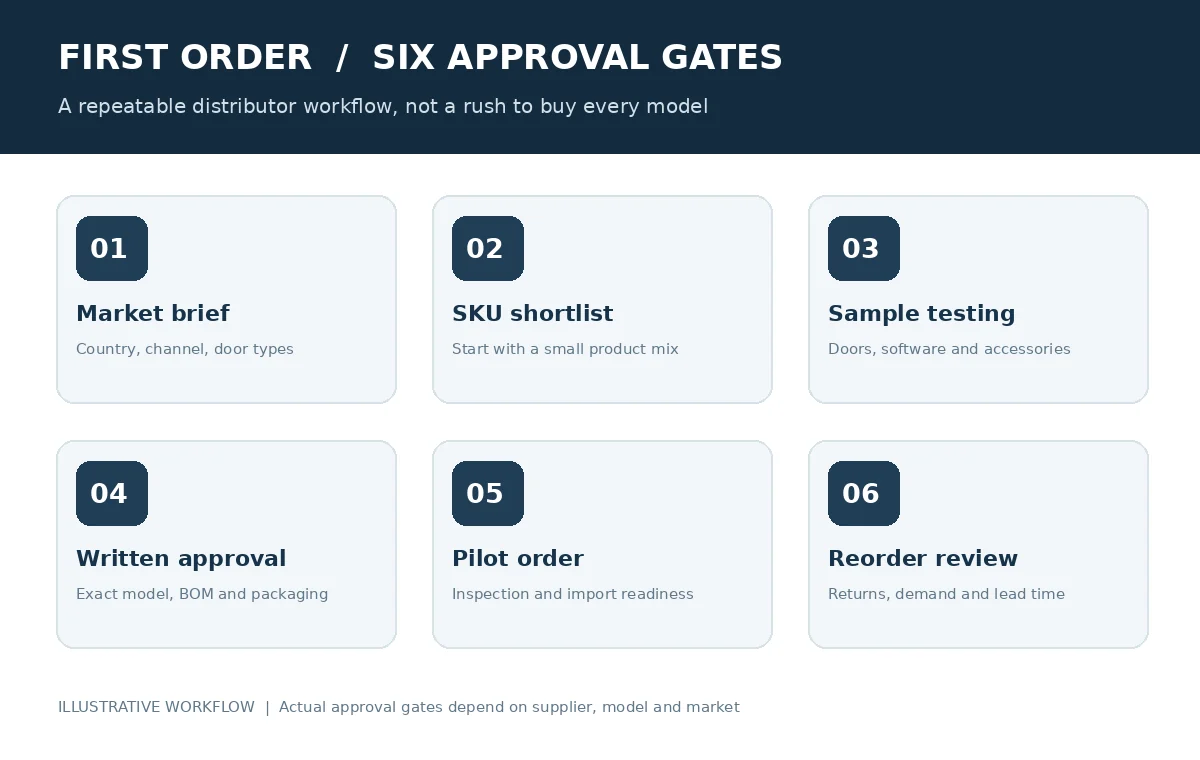
Keep a short defect and installation log during the pilot. Record the exact model/version and what happened. This allows you to separate a manufacturing issue from a fit error, missing accessory, misunderstood operating mode or installation training problem. If the sample specification changes later, request renewed confirmation rather than assuming the new shipment is identical.
Calculate Landed Cost Before Setting Retail Prices
Wholesale purchasing is a margin decision. A distributor's landed cost is broader than the factory unit price. Depending on the agreed trade term and local rules, it may include origin charges, international shipping, insurance, customs duties, clearance, inland delivery, local labels, samples, storage and the expected cost of replacements or returns.
Working formula: approximate landed cost per saleable unit = (product cost + relevant freight/insurance + duties and non-recoverable import charges + clearance + local delivery + other attributable costs) ÷ expected saleable units. Then assess channel margin, installation support, retailer discounts, warranty reserve and payment timing separately. Recoverable taxes may affect cash flow without being a final product cost; your customs broker and accountant should confirm treatment.
Always check the named Incoterm and what the supplier quotation actually covers. Two identical unit prices quoted under different shipping terms may produce different landed costs. A distributor also needs a buffer for damaged cartons, slow-selling variants and replacement accessories. Do not set a retail or reseller price from the supplier's unit price alone.
This guide deliberately does not publish universal wholesale prices: price tiers depend on the actual model, specifications, quantity, customization and shipment terms, and any country-specific import charges require current local verification.
Define Quality, Warranty and Spare-Parts Responsibilities
Local distributors are usually the first party customers contact after installation. Before accepting a first shipment, agree on a practical troubleshooting and replacement process rather than accepting only the phrase “one-year warranty” or “technical support available.” The useful questions are operational: who diagnoses a failure, what photos or logs are required, who pays return freight, and what replacement units or parts can be supplied?
Request a list of serviceable or replaceable components applicable to the selected models. Depending on design, that may include keys, screws, latches, mortise components, handles, electronic boards or other accessories—but availability and field replacement must be confirmed; do not assume every smart lock is user-serviceable.
For app-enabled models, agree on how installers and end users obtain setup instructions, how accounts are supported and how firmware or app dependencies are communicated. For hotel and locker systems, define the encoder, credential, management software and operational support boundaries separately from door hardware.
Before shipment, document inspection criteria for appearance, stated functions, the approved hardware version, supplied accessories, labels, manuals and packaging. Ask how the supplier reports nonconformities and handles specification changes. A reliable process is more useful than an unsupported “zero defects” promise.
Prepare Logistics, Documents and Reorder Rules
An importer should agree in advance which party provides commercial invoices, packing lists, relevant transport documents and product-specific conformity or battery/shipping records when applicable. Required documents differ by destination, route and product, particularly where locks include batteries or separate wireless gateways. Confirm with your freight forwarder and customs broker before the goods are dispatched.
Ask for carton quantities, dimensions and weights for the quoted SKUs. Those figures affect freight planning and storage costs. They are model-specific: for instance, the C17 hotel RFID lock page lists a particular carton configuration, but a different product or accessory bundle may pack differently. Request the final packing list for your own order.
Before choosing a reorder trigger, consider actual demand, lead time, customs transit, returns and safety stock. During the first pilot, measure sell-through and support burden by SKU. Reorder the models with proven demand rather than extending the catalogue merely because the factory offers more products.
Distributor's First-Order Checklist
Use these questions as a final pre-order review. The goal is not to collect paperwork for its own sake; every unanswered item is a potential installation, inventory or customer-support risk.
- Market: Which country, reseller channel and customer segment will buy each model?
- Product mix: Which small group of SKUs can we demonstrate and support locally?
- Door fit: Are door thickness, handing, backset, mortise and cut-out verified?
- Electronics: Are access methods, app/software versions, gateways and batteries documented?
- Samples: Have representative units passed installation and user-workflow tests?
- Quotation: Are model versions, MOQ by SKU, price tiers, accessories and Incoterms written down?
- Compliance: Are destination-market obligations and model-specific documents verified?
- Packaging: Are manuals, labels, carton dimensions, contents and branding approved?
- Warranty: Are claims, spares, troubleshooting and replacement responsibilities agreed?
- Reorder: Are lead-time assumptions, approved configurations and replenishment steps documented?
For procurement review, ask suppliers to reply against the same checklist. This makes it easier to compare offers and identify missing items before the first payment.
Frequently Asked Questions
Can I buy smart lock samples before a wholesale order?
Samples are commonly used to evaluate fit, functions and installation before larger purchasing decisions. Ask the supplier which models are available for evaluation, their prices, shipping terms and whether the sample matches the intended production configuration. SmartLockMarket can review sample requests by selected model; terms are confirmed in the quotation.
Can a distributor mix several smart lock models in one first order?
A mixed-SKU order may be possible, but stock, production rules, per-model MOQ, packaging and pricing can differ. Provide the model mix and quantity per SKU and request confirmation in writing before budgeting. Do not assume a total-order MOQ automatically applies to every variant.
What is the minimum order quantity for wholesale smart locks?
There is no safe universal number across all smart locks. MOQ can vary by model, board or lock-body configuration, packaging, logo, finish and development requirements. Separate sample, standard-product pilot, mixed-order and private-label quantities when requesting a quotation.
Should I choose TTLock or Tuya for resale?
Choose the platform according to the exact model, your customers' desired workflow and your ability to provide local setup support. Confirm supported access methods, account, app, gateway or integration behavior on a configured sample. Do not assume the platforms are interchangeable or that every model offers both.
Can I sell a smart lock under my own local brand?
Private-label options may be available for suitable models, including certain logo, packaging or manual changes. The customization scope, approvals, MOQ and costs must be agreed separately. A private-label decision should come after selecting and testing a model customers can install and support.
What should be included in a distributor's wholesale price request?
Specify destination country, business channel, candidate models, door types, functions/platform, sample and first-order quantities, packaging and branding needs, Incoterm and requested shipment timing. Ask for unit pricing by configuration, accessory inclusions, lead time, inspection scope and after-sales terms in the same response.
How do I reduce returns after importing smart locks?
Test on representative local doors, publish accurate compatibility instructions, train installers, identify the supplied model/firmware version and maintain a practical warranty and spare-parts process. Track pilot failures and reasons for returns before ordering more units. No supplier can guarantee zero returns, but documented approval and support reduce preventable errors.
Request a Distributor Wholesale Quotation
SmartLockMarket supplies smart locks for B2B buyers including importers, distributors, wholesalers and private-label partners. We can review suitable existing product categories, model configurations, sample requirements and available order options; final pricing, MOQ, certificates, customization and lead time are confirmed for the quoted model and market.
To receive a useful first quotation, send: your company and destination country, sales channel, target door or locker applications, models of interest, required access methods and platform, sample quantity, estimated first bulk quantity, branding needs and preferred trade terms. If you have door photos or dimension drawings, include them.
Contact SmartLockMarket to request a wholesale smart lock quotation and sample plan, or email sales@smartlockmarket.com with the subject “Distributor First Order — Smart Locks”.