smartlockmarket.com

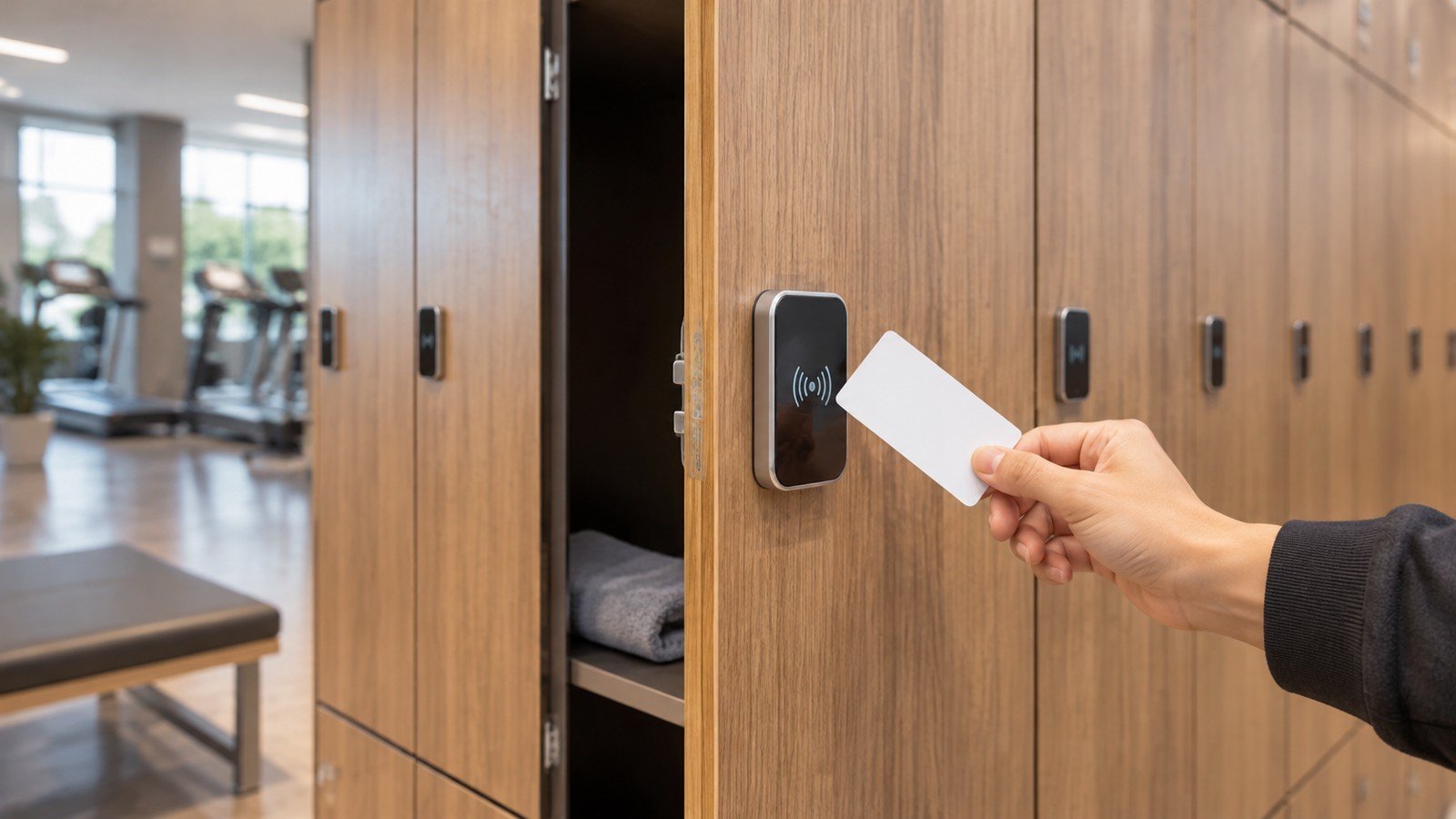
RFID Locks for Laminate Lockers: HPL Compatibility Checks Before Bulk Ordering
An RFID locker lock can work with some laminate and HPL locker doors, but the word “laminate” alone is not enough to confirm compatibility. Before approving a model, buyers need to identify the panel construction, check whether the decorative finish contains a metallic layer, confirm the lock’s mounting arrangement, and test RFID reading on the actual finished door.
The important distinction is that laminate lockers are not all built the same way. A compact HPL panel, a wood-composite door with a laminate surface, and a door finished with a metallic decorative film can present different installation and RFID conditions. For importers, distributors and locker manufacturers, the safest approach is to confirm the exact panel and lock combination before placing a bulk order.
Table of Contents
1. Identify the Actual Laminate Panel Construction
“Laminate locker” is a broad description. Ask the locker manufacturer what the door is made of, rather than relying only on the finish name or product photo.
| Locker door construction | What to confirm before selecting an RFID lock |
|---|---|
| Compact HPL or phenolic panel | Actual panel thickness, edge construction, fixing method and available mounting space |
| MDF, particleboard or plywood with a laminate surface | Core material, total door thickness, screw-holding area and the location of the lock body |
| Decorative laminate with a metallic or foil layer | Whether the layer contains metal, where it sits in relation to the reader antenna, and whether the finished panel passes an RFID test |
| Laminate door with a metal frame or reinforcement | Distance between the reader and nearby metal parts, mounting position and latch alignment |
Some commercial RFID lock ranges are specifically described by their suppliers as suitable for phenolic or wood-laminate lockers. That does not mean every RFID lock is suitable for every HPL door. Compatibility must be confirmed for the exact model and panel construction.
2. Why a Metallic Finish Can Matter to RFID
An RFID reader uses a radio-frequency field to communicate with a card, wristband or tag. Conductive material close to the reader antenna can affect that field. A metallic decorative foil, metal backing plate or nearby metal frame may therefore change reading performance.
This is a model-specific issue, not a reason to reject every laminate locker. A non-metallic laminate finish should not automatically be treated as an RFID barrier, and a product description that says “RFID” does not prove that the lock will read reliably through every finished door assembly.
Ask the locker supplier to confirm whether the panel includes a metallic film, foil, mesh or backing layer. If the construction is uncertain, test a sample using the same finish, thickness and metal components that will be used in production.
3. Check the Lock Specification—Not Just the Product Photo
The front appearance of a lock does not show its mounting cut-out, rear housing, antenna location or clearance requirements. Request the drawing and specification for the exact version being quoted.
The current SmartLockMarket product pages provide the following confirmed public specifications:
| Model | Access method | Material | Listed dimensions | Unit weight |
|---|---|---|---|---|
| EM108 | RFID | Zinc alloy | 104 × 50 × 16 mm | 286.8 g |
| EM110 | RFID | Zinc alloy | 110 × 36 × 11 mm | 282.6 g |
Both product pages list 66 sets per carton. These are listed product dimensions; they should not be treated as door cut-out dimensions or proof of fit on a particular HPL panel.
The public specifications currently do not state a confirmed HPL compatibility range, supported door thickness, RFID frequency/chip standard or IP rating for these two models. Buyers should request model-specific confirmation before including those claims in a project specification.
See the EM108 RFID Locker Lock and EM110 RFID Locker Lock pages for their published details.
4. Five Checks to Complete Before Ordering Samples
Check 1: Get the panel build-up in writing
Ask for the panel brand or type, core material, total thickness, surface finish and any metallic layer or backing. If the locker maker cannot provide a full material description, request a physical door sample or a cross-section photograph.
Check 2: Measure the actual door and installation area
Record the door thickness, front and rear clearance, existing cut-out, screw positions, distance to the door edge, hinge location and frame position. For a new locker, coordinate the lock drawing with the locker manufacturer before holes are drilled.
Check 3: Confirm the mechanical fit
Check the lock body, mounting method, latch or cam, opening direction and the distance between the latch and the locker frame. The front panel dimensions alone are not enough to approve a replacement or a new installation.
Check 4: Confirm the RFID credential
Provide the actual card, wristband or tag specification. If known, include the frequency, chip type and card format. Do not assume that two products are compatible simply because both are described as RFID. The EM108 and EM110 public pages identify RFID access but do not publish a specific frequency or chip standard.
Check 5: Test the complete finished assembly
Install a sample lock on a representative locker door using the production-intent finish and hardware. Test the intended card or wristband at the normal user position, repeat the read operation, and check that the door closes and the latch engages correctly. Record any missed reads, required card position changes or mechanical adjustments.
A test on an unfinished panel is not a substitute for testing the final finished door. If the production finish, panel thickness or metal frame changes, repeat the compatibility check.
5. What to Send a Supplier for an Accurate RFQ
For a useful quotation and technical review, send the following information together:
| Information | Details to provide |
|---|---|
| Locker panel | HPL, phenolic, MDF/laminate, plywood/laminate or other construction |
| Panel build-up | Core material, surface layers and any metallic foil or backing |
| Door thickness | Actual measured thickness in millimetres |
| Installation | Existing cut-out, mounting holes, internal clearance and door-edge distance |
| Mechanical layout | Hinge side, opening direction, frame and latch/cam requirements |
| RFID credential | Card, wristband or tag; frequency/chip details if known |
| Application | Gym, spa, school, office, staff locker or another use |
| Quantity | Sample quantity and estimated bulk quantity |
| Destination | Country and delivery location |
| Project conditions | Humidity, proximity to water and any special operating requirements |
For replacement projects, include clear photographs of the front, rear and edge of the locker door, plus a photograph of the existing lock area. For new projects, provide the locker drawing and the proposed panel specification.
6. Use a Sample Approval Record Before Bulk Production
A sample should be approved against the actual purchasing requirements—not simply because the lock powers on or opens once.
| Approval checkpoint | Evidence to retain | Decision |
|---|---|---|
| Panel construction | Panel specification or cross-section photo | Confirmed / Pending |
| Surface finish | Production-intent finish sample | Confirmed / Pending |
| Lock installation | Model-specific drawing and sample fit | Pass / Fail |
| RFID operation | Test using the intended card or wristband on the finished door | Pass / Fail |
| Door operation | Closing, latch engagement and opening test | Pass / Fail |
| Final configuration | Model, finish, credential and mechanical details recorded | Approved / Hold |
If any critical item remains pending, keep the bulk order on hold until the supplier and buyer agree on the final configuration in writing. The approved sample and the production order should use the same model and material configuration, or any change should be documented and retested.
7. Questions Distributors Should Ask Before Stocking
If you are an importer or distributor planning to stock RFID locker locks for laminate-door projects, ask your supplier:
- Which exact panel constructions have been tested with this lock model?
- Are there any restrictions involving metallic decorative films, foil or metal backing?
- What are the confirmed RFID frequency, chip and credential requirements?
- Can you provide a dimensioned drawing showing the front panel, rear body and mounting points?
- Can the sample be tested on a representative finished locker door before the bulk order?
- Will the bulk order match the approved sample configuration?
Keep the answers with the quotation and sample approval record. This makes it easier to compare suppliers and reduces the risk of relying on a general product description.
Frequently Asked Questions
Does HPL itself block RFID signals?
There is no universal answer based only on the term HPL. The complete panel construction, any metallic layer, the reader design and antenna position all matter. Confirm the exact finished panel and test it with the selected lock.
Can any RFID locker lock be installed on a laminate door?
No. Mounting dimensions, door thickness, fixing method, latch position and RFID performance vary by model. Request the model-specific drawing and confirm compatibility before ordering.
Are EM108 and EM110 confirmed for HPL lockers?
Their current public product specifications identify them as zinc-alloy RFID locker locks and list their product dimensions and weights. They do not publish a confirmed HPL door range or metallic-finish test result. Ask SmartLockMarket to review the panel details and confirm the exact configuration before making a project commitment.
Should I test the lock on the final locker finish?
Yes. Test the lock on a representative door with the same core, finish, thickness and nearby metal components planned for production. A test on a different or unfinished panel may not represent the final installation.
Request an RFID Locker Lock Review
If you are sourcing RFID locker locks for HPL, phenolic or other laminate-door projects, send SmartLockMarket the panel specification, door thickness, finish details, installation photos or drawings, RFID credential information and estimated quantity.
Our team can review the available product options and confirm which model-specific details need to be checked before samples or a wholesale quotation are prepared.
Browse the Locker RFID Locks product range or contact sales@smartlockmarket.com with your project requirements.
Further supplier references
These supplier pages describe model-specific compatibility information; they do not verify EM108 or EM110 fit on a particular HPL panel: Ideal Products Zephyr 2154, Synolock RFID locks for wooden lockers, and Lockertek RFID locker locks.