smartlockmarket.com

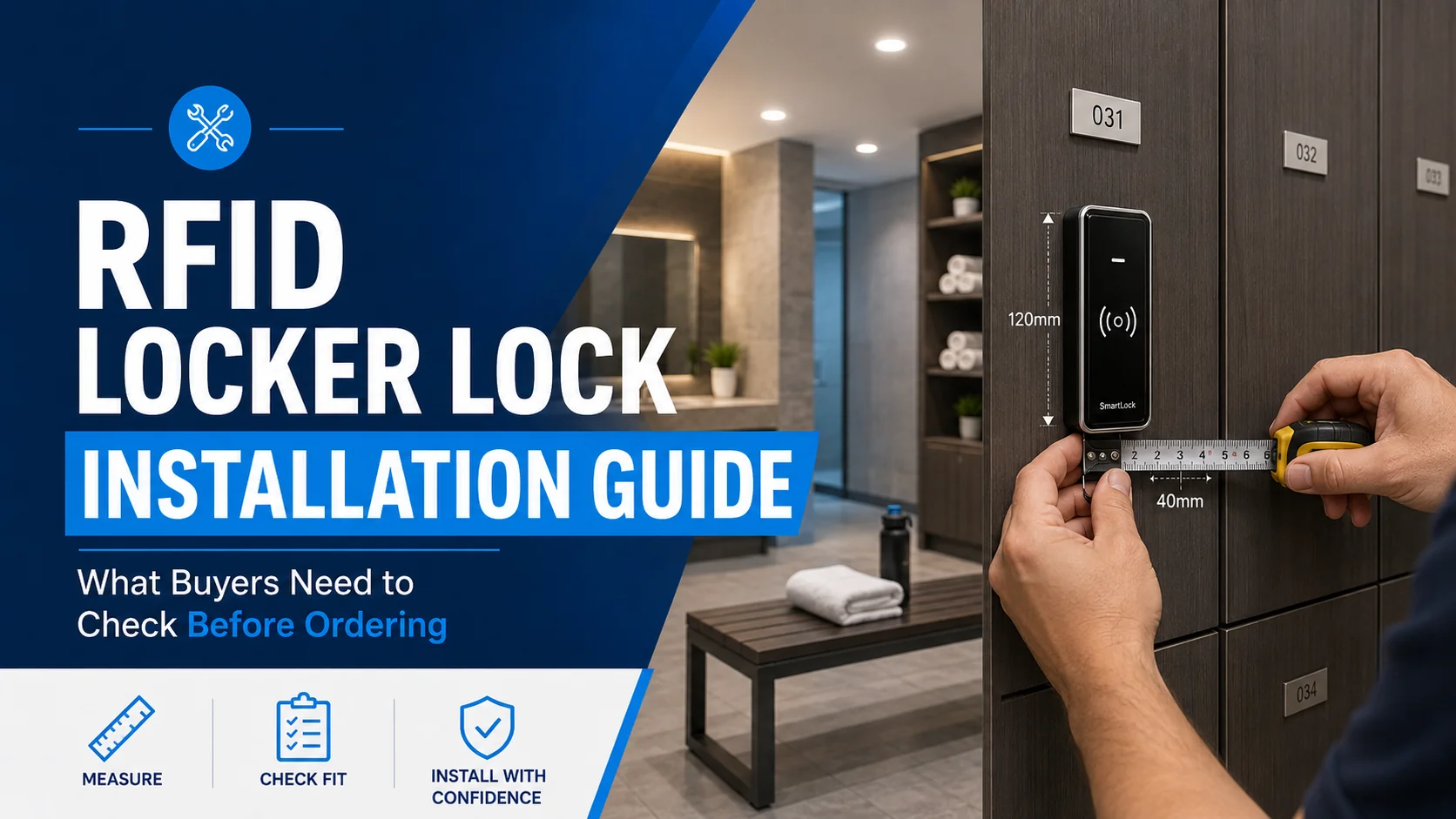
RFID Locker Lock Installation Guide: What Buyers Need to Check Before Ordering
Choosing an RFID locker lock is not only about card access, appearance, or price.
For gyms, spas, swimming pools, schools, offices, and other commercial facilities, one practical question usually matters more: Will the RFID locker lock actually fit the locker and work correctly after installation?
Installation problems can happen when buyers order locks before checking door thickness, locker material, internal space, latch position, opening direction, or RFID card compatibility. For B2B projects, these issues can become expensive when hundreds of lockers are involved.
This guide explains what buyers should check before ordering RFID locker locks, what information to send to a supplier, and why sample testing is recommended before a bulk order.
Check the Locker Material First
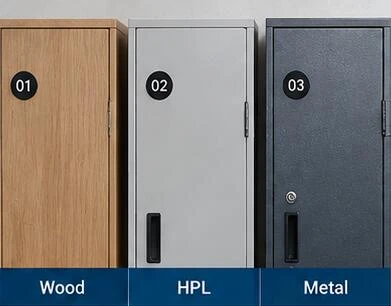
The first thing to confirm is the material of the locker door.
Common locker materials include:
- Wood
- MDF
- HPL
- Metal
- Plastic
- Composite panels
Different materials may require different mounting methods.
For example, a wooden or HPL locker door may allow the lock to be fixed directly using screws, while a thin metal locker door may require additional support, a mounting plate, or a different lock structure.
This is especially important when upgrading existing lockers from mechanical locks to electronic RFID locker locks.
Before choosing a lock model, send the supplier clear photos of:
- The locker door
- The inside of the door
- The locker frame
- The existing lock area
- The hinge position
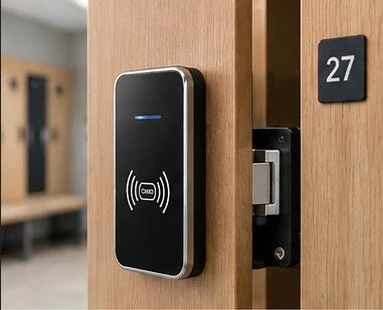
A lock should be selected based on the real locker structure, not only the appearance of the lock.
Confirm the Locker Door Thickness
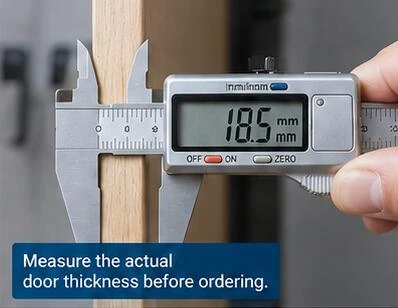
Door thickness is one of the most important installation measurements.
An RFID locker lock usually includes a front panel, internal lock body, fixing screws, latch, and other installation components. These parts must match the actual door thickness.
If the locker door is too thick:
- Standard screws may be too short
- The lock body may not connect correctly
- The latch may not reach the correct position
If the locker door is very thin:
- The lock may not sit firmly
- Additional support may be required
- The door may flex during use
Before ordering, measure the real door thickness.
For commercial projects, it is better to measure an actual locker sample rather than relying only on catalogue specifications from the locker manufacturer.
Check the Available Installation Space
Many buyers only look at the front panel of the lock. However, the space behind the locker door is just as important.
The internal lock body, battery compartment, screws, latch, and wiring structure must fit inside the locker without interfering with other parts.
Check whether there is enough space around:
- Internal shelves
- Locker frames
- Hinges
- Reinforcement structures
- Dividers
- Hooks
- Battery access areas
For smaller lockers, limited internal space can be a major installation issue.
A lock that looks suitable from the outside may still be difficult to install if the internal body is too large.
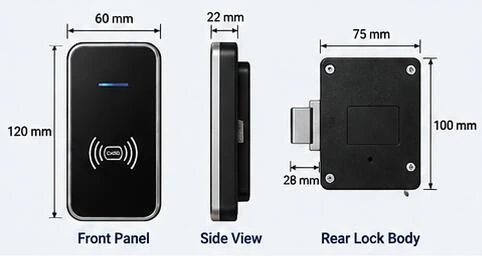
Confirm the Lock Dimensions Before Opening Holes
Do not drill or cut the locker door before receiving the correct installation drawing.
A proper installation drawing should normally include:
- Front panel size
- Rear lock body size
- Mounting hole positions
- Screw positions
- Latch position
- Cutout dimensions
- Required clearances
For new locker projects, the best approach is usually:
Choose the locker lock first, then manufacture the locker door around the confirmed installation dimensions.
This can reduce:
- Rework
- Additional drilling
- Wrong hole positions
- Installation delays
- Extra labor costs
If the lockers have already been manufactured, the lock model should be selected based on the existing dimensions.
Check the Locker Opening Direction
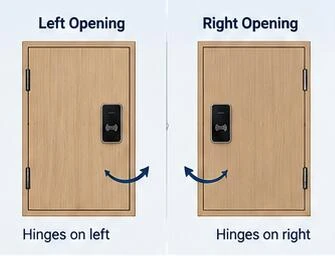
Locker doors can have different opening directions.
Some lockers are left-opening, while others are right-opening.
The correct installation depends on:
- Hinge position
- Lock body orientation
- Latch direction
- Door opening direction
Some RFID locker lock models can support both directions. Other models may require a specific configuration.
For projects using both left-opening and right-opening lockers, inform the supplier before ordering.
A simple locker photo with the hinge side marked can prevent installation mistakes.
Confirm the Latch and Locker Frame Position
An electronic locker lock cannot work correctly if the latch does not align with the locker frame.
When the lock closes, the latch must engage correctly with the strike area or locker structure.
Buyers should check:
- Distance from the lock to the cabinet frame
- Door gap
- Latch travel
- Strike position
- Frame thickness
- Closing alignment
If the latch is too short, too long, or positioned incorrectly, the RFID system may function normally but the locker door may still fail to lock securely.
This is why mechanical compatibility is just as important as electronic functions.
Check Whether Existing Lock Holes Can Be Reused
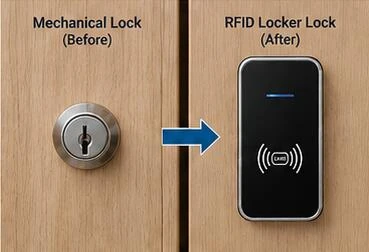
For renovation projects, gyms and spas often want to replace existing mechanical locker locks without replacing the whole locker.
In this case, check whether the existing lock opening can be reused.
Measure:
- Existing round hole diameter
- Existing rectangular cutout size
- Distance from the lock hole to the locker edge
- Existing screw hole positions
- Existing latch position
- Available installation space
Send these measurements together with clear photos.
The supplier can then determine whether:
- The existing opening can be reused
- A mounting plate is needed
- A new cutout is required
- Another RFID locker lock model would be more suitable
This step can significantly reduce renovation costs.
Confirm the RFID Card Type
Mechanical installation is only one part of the project. The RFID card system must also match the facility's operating requirements.
Before ordering, confirm:
- RFID card technology
- Supported card frequency
- Card registration method
- Master card support
- User card capacity
- Encoder requirement
- Existing access card compatibility
- Management mode
For gyms, spas, hotels, and swimming pools that already use RFID cards, buyers often want the same card to work across multiple systems.
This may be possible, but it should never be assumed. The supplier should confirm compatibility before the bulk order.
Decide Between Public Mode and Private Mode
The operating mode affects how users interact with the lockers.
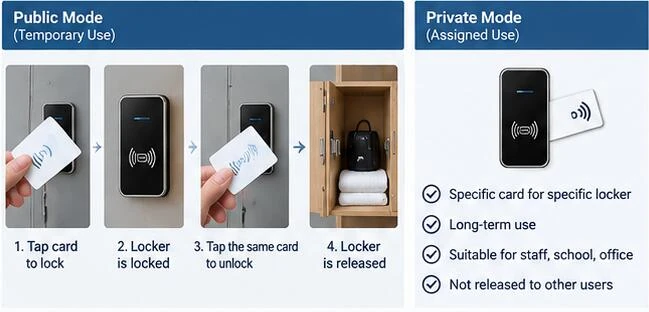
Public Mode
Public mode is commonly used where different users temporarily use available lockers.
Typical applications include:
- Gyms
- Fitness centers
- Spas
- Swimming pools
- Sauna facilities
- Temporary storage areas
A user chooses an available locker, locks it with an RFID card, and uses the same card to reopen it. After opening, the locker becomes available for another user.
Private Mode
Private mode assigns a specific locker to a specific card or user.
Typical applications include:
- Employee lockers
- School lockers
- Office lockers
- Membership clubs
- Long-term personal storage
The correct mode should be selected according to how the facility operates. Do not choose a lock only based on hardware appearance.
Check the Battery Replacement Method
Most standalone RFID locker locks are powered by batteries.
For a single locker, battery replacement is simple. For a facility with hundreds of lockers, battery maintenance becomes an operational issue.
Before ordering, check:
- Battery type
- Battery compartment location
- Low-battery warning
- Emergency power method
- Emergency opening method
- Battery replacement procedure
The battery compartment should remain accessible after the lock is installed. Maintenance convenience becomes especially important in gyms, spas, schools, and large commercial facilities.
Consider Humidity for Gyms and Spas
Locker rooms in gyms, spas, swimming pools, and sauna facilities may have higher humidity than ordinary office environments.
Before selecting a lock, ask whether it is suitable for the expected installation environment.
Important points include:
- PCB protection
- Moisture resistance
- Surface material
- Corrosion resistance
- Recommended operating environment
- Installation distance from showers or pools
Do not automatically assume an RFID locker lock is waterproof. Waterproof, moisture-resistant, and suitable for humid environments are not the same thing.
For lockers near showers or swimming pools, tell the supplier where the lock will be installed before ordering.
Request an Installation Drawing Before Bulk Ordering
For B2B projects, the installation drawing should be confirmed before the bulk order.
Before requesting final production, provide the supplier with:
- Locker material
- Door thickness
- Door dimensions
- Internal installation space
- Opening direction
- Existing hole dimensions
- Locker photos
- Required RFID card type
- Public or private mode
- Estimated order quantity
The supplier can then recommend the correct model and confirm whether any installation changes are required.
This process is more reliable than selecting a lock based only on product photos.
Order Samples Before a Large Project
For larger projects, sample testing is strongly recommended.
A sample allows the buyer to verify the lock on the actual locker.
Test:
- Physical installation
- Door opening and closing
- Latch alignment
- RFID card operation
- Master card operation
- Public or private mode
- Battery access
- User experience
- Appearance after installation
The best test is not simply holding the lock in your hand. Install the sample on the real locker that will be used in the project.
After the sample is confirmed, the same configuration can be used for mass production.
Information to Send Your RFID Locker Lock Supplier
Providing complete information can help the supplier recommend the correct product faster.
Locker Information
Provide:
- Locker material
- Door thickness
- Door dimensions
- Internal installation space
- Hinge position
- Left or right opening
- Existing lock hole dimensions
- Photos
- Drawings if available
Project Information
Also provide:
- Application
- Quantity
- Destination country
- Public or private mode
- RFID card type
- Existing access control system
- Required logo
- OEM requirements
- Packaging requirements
- Project schedule
For example:
Application: Gym locker project
Locker material: HPL
Door thickness: Actual measured thickness
Quantity: 300 lockers
Mode: Public mode
RFID system: Existing membership card system
Requirement: Sample testing before bulk order
This is much more useful than simply asking: "Please send your RFID locker lock price."
RFID Locker Lock Pre-Order Checklist
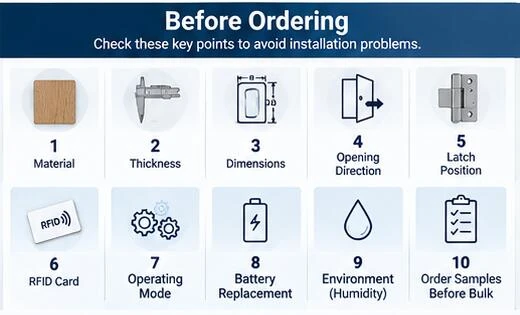
| Item | What to Confirm |
|---|---|
| Locker material | Wood, MDF, HPL, metal, plastic, etc. |
| Door thickness | Actual measured thickness |
| Internal space | Enough room for the rear lock body |
| Opening direction | Left or right |
| Lock dimensions | Confirm installation drawing |
| Existing lock hole | Measure if replacing old locks |
| Latch position | Must align with locker frame |
| RFID card | Confirm card technology and compatibility |
| Operating mode | Public mode or private mode |
| Environment | Normal, humid, spa, pool, etc. |
| Battery maintenance | Easy access after installation |
| Sample testing | Recommended before bulk order |
Common Mistakes Buyers Should Avoid
Mistake 1: Choosing a Lock Only by Appearance
Two RFID locker locks may look similar but have completely different internal structures. Always compare installation drawings.
Mistake 2: Ignoring Door Thickness
A lock that works on one locker door may not work on another. Measure the real door before ordering.
Mistake 3: Assuming Existing RFID Cards Are Compatible
Different RFID systems may use different technologies or configurations. Compatibility must be confirmed.
Mistake 4: Ordering Bulk Quantity Before Testing
Testing one or several samples can prevent much larger problems later.
Mistake 5: Sending Only Locker Dimensions
Dimensions alone may not show internal shelves, frames, hinges, or existing lock structures. Photos are also important.
Mistake 6: Ignoring Maintenance
A lock may be easy to install but difficult to maintain. Battery access and emergency opening should be checked before the project is confirmed.
Frequently Asked Questions
Can RFID locker locks be installed on wooden lockers?
Yes. Many RFID locker locks can be installed on wooden, MDF, or HPL lockers. The correct model depends on door thickness, installation space, and fixing structure.
Can RFID locker locks be installed on metal lockers?
Yes, many models can be used on metal lockers. However, the mounting method may be different from wooden lockers, especially when the metal panel is thin.
Can I replace a mechanical locker lock with an RFID locker lock?
In many cases, yes. The existing hole size, latch position, locker frame, and available space should be checked first.
Can an existing gym membership card work with the locker lock?
Possibly. Compatibility depends on the RFID card technology and system configuration. The card should be tested or confirmed before bulk ordering.
What is public mode?
Public mode allows users to select any available locker temporarily. It is commonly used in gyms, spas, pools, and fitness centers.
What is private mode?
Private mode assigns a specific locker to a specific card or user. It is commonly used for staff, schools, offices, and long-term locker assignments.
Should I order a sample before placing a bulk order?
Yes, especially for commercial projects. Installing a sample on the actual locker is one of the best ways to confirm compatibility.
What should I send the supplier before requesting a quotation?
At minimum, provide locker material, door thickness, photos, opening direction, quantity, application, RFID requirements, and public or private mode.
Final Checklist Before Ordering
Choosing the right RFID locker lock should follow a simple process:
Locker structure → Installation dimensions → RFID compatibility → Operating mode → Sample testing → Bulk order
Before confirming the order, make sure you know:
- What material the locker uses
- The actual door thickness
- The available internal space
- The opening direction
- The correct installation dimensions
- The latch position
- The RFID card requirements
- The required operating mode
- The installation environment
- The battery maintenance method
For large projects, confirming these points before production can reduce installation problems, delays, and unnecessary modification costs.
If you are still comparing different RFID locker lock options, read our RFID Locker Locks Buying Guide: How to Choose the Right Lock for Gyms & Spas. It explains how to compare RFID locker locks based on application, operating mode, card system, management requirements, and commercial project needs.
SmartLockMarket supplies locker RFID lock solutions for gyms, spas, swimming pools, fitness centers, schools, offices, and commercial locker projects. Buyers, distributors, contractors, and project companies can send locker photos, dimensions, application requirements, and estimated quantities before ordering. This information helps confirm a more suitable lock model before sample testing or bulk production.
Contact SmartLockMarket for RFID locker lock samples, project quotations, installation support, and OEM/ODM requirements.